Posted on March 2, 2026 · By Echoes of Kin Genealogy
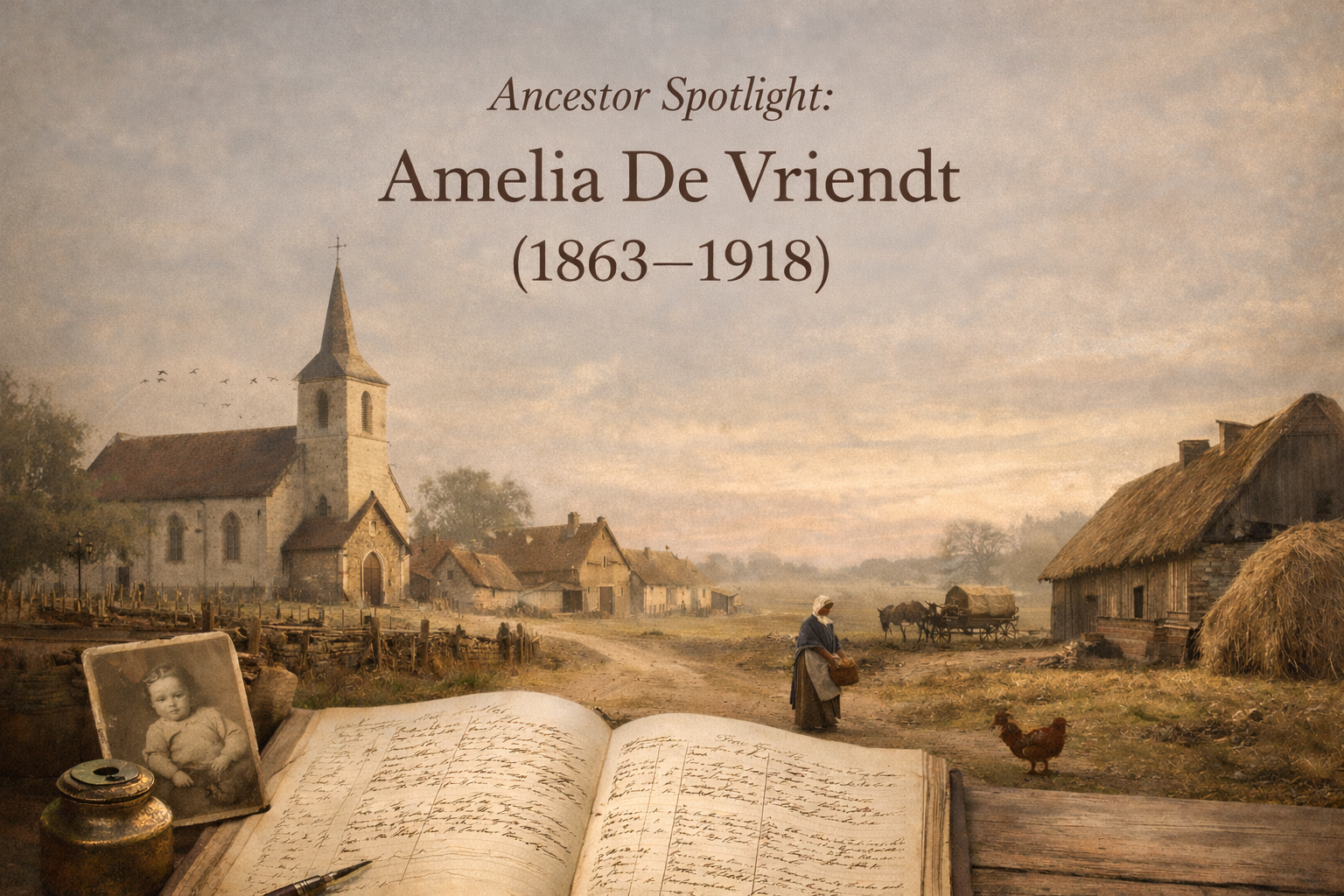
On February 7, 1863, in the rural village of Lotenhulle in Oost-Vlaanderen, Belgium, Amelia De Vriendt was born to Augustinus De Vriendt and Rosalia Van Veirdeghem. As their first child, her life began in a landscape shaped by small farms, parish churches, and tightly knit Flemish communities.
The parish registers of nineteenth-century East Flanders carefully recorded baptisms, marriages, and burials, preserving the milestones of lives that might otherwise have faded quietly into history. Through those records—and later American documents—we can trace the steady arc of Amelia’s journey from Belgium to Indiana, from daughter to wife, from immigrant mother to matriarch.
Her World — Rural Flanders in the 1860s and 1870s
Lotenhulle and nearby Aalter were agricultural communities. In mid-nineteenth-century East Flanders, families often relied on small-scale farming, seasonal labor, and cottage industries. The region had endured economic strain in the decades before Amelia’s birth, including agricultural downturns and limited industrial opportunity.
While we do not have a record naming her father’s occupation here, most families in the region were connected in some way to farming or rural trades. Catholic faith structured community life; parish churches served not only spiritual needs but also social and civic identity. Amelia would have grown up in a world where family reputation, church affiliation, and local ties mattered deeply.
This is the environment that shaped her early years before marriage and migration altered her path.
Marriage and Young Motherhood
At age twenty-two, Amelia married Theophiel Coddens on April 15, 1885 in Aalter, Oost-Vlaanderen. The marriage record anchors her firmly in her home province as a young adult.

In the years that followed, Amelia and Theophiel welcomed several children in Belgium:
- Achille Joseph “Adiel” Coddens (born 5 November 1885)
- Henry Coddens (born 11 May 1888)
- Erma M. Coddens (born 6 June 1888)
- Adolph Coddens (born 25 July 1889 in Waarschoot, Oost-Vlaanderen)
- Laura Coddens (born 5 March 1893)
- A child recorded as Coddens who died before 1900
The close spacing of these births reflects the rhythm of many nineteenth-century families. Infant and child mortality was an ever-present reality; the record of a child who died before 1900 is a quiet reminder of that vulnerability.
Immigration — A Turning Point

Family records state that Amelia arrived in the United States in 1893. That same year, Laura was born in Belgium, suggesting that the migration likely occurred later in the year or shortly thereafter.
Belgian immigration to northern Indiana increased in the late nineteenth century, particularly to areas like South Bend and surrounding communities. These regions offered industrial employment and established Belgian Catholic networks. Such networks often eased the transition for newcomers by providing familiar language, faith, and community support.
This pattern reflects what historians often describe as chain migration — the process by which earlier immigrants encouraged or assisted relatives and neighbors to follow. Much like the German families who moved westward into Nebraska during this same period, Belgian families in South Bend created what some have called a “New Flanders” in Indiana. They brought their faith, their work ethic, and their community networks with them, ensuring that streets like 1207 W. Thomas Street felt, in meaningful ways, connected to places like Aalter.
By 1900, Amelia was living in Portage Township, St. Joseph County, Indiana, at 1207 W. Thomas Street, listed in the federal census as married and the wife of the head of household. By 1903, she remained at that address in South Bend, and by 1910, the family resided at 618 W. Division Street.
These addresses place her squarely within South Bend’s working-class neighborhoods during a period of industrial growth. Factories such as the Studebaker works and other manufacturing plants drew immigrant laborers from across Europe. While we do not have direct evidence of her husband’s occupation in this summary, the setting suggests a household connected to the city’s industrial economy.
Widowhood and Remarriage
Sometime before 1897, Amelia’s first marriage ended—though the specific circumstances are not detailed here. On January 22, 1897, at age thirty-three, she married Emil C. Dobbelaere in St. Joseph County, Indiana. No children are recorded from this second marriage.
Remarriage among immigrant families was not uncommon, particularly when stability and economic partnership were essential for raising children in a new country. Amelia’s remarriage suggests resilience and practicality—qualities often required of immigrant mothers navigating unfamiliar systems and responsibilities.
The Lives of Her Children
Amelia lived to see her children establish lives in Indiana:
- Achille Joseph “Adiel” Coddens married Emma Marie Cobert in 1908 and died in 1929 in a hunting accident.
- Henry Coddens married Marie Mary Cobert in 1916.
- Erma M. Coddens married Albert Van Paris and lived until 1957.
- Adolph Coddens married Wladyslawa “Lottie” Bednarowicz and died in 1940 after being struck by a car at Western Avenue and Cherry Street in South Bend.
- Laura Coddens married Clyde Curtis Hyatt in Michigan in 1912 and later married Edward N. “Eddie” Morris in South Bend.
Through these marriages, the family’s Belgian roots intertwined with other immigrant and American families, expanding their cultural and geographic ties.
Final Years and Burial
Amelia died on July 15, 1918 in South Bend, St. Joseph County, Indiana. Her death record is preserved in Book CH-49, page 17, within the Indiana Works Progress Administration (WPA) series — a Depression-era records preservation project that indexed and abstracted vital records across the state. For Indiana researchers, these WPA volumes remain an essential and sometimes overlooked resource, particularly when original courthouse records are difficult to access.
She was buried at Cedar Grove Cemetery in Notre Dame, St. Joseph County, Indiana. Burial in a Catholic cemetery reflects continuity with the faith tradition of her Belgian upbringing.

Her death occurred in 1918, the year of the influenza pandemic and during the final year of World War I. While no cause of death is noted here, her passing came during a time of global upheaval and public health crisis.
Character & Legacy — A Life Between Two Worlds
Amelia’s life traces a path common to many nineteenth-century European immigrants yet deeply personal in its details:
- Born in a small Flemish village
- Married and began her family in Belgium
- Crossed the Atlantic in her thirties
- Raised her children in an industrial American city
- Remarried and maintained her household in a growing immigrant community
Her choices—especially migration—reshaped the direction of her descendants. Without her journey in 1893, future generations would not have been rooted in Indiana soil.
Her life suggests steadiness. The records show movement, adaptation, and endurance. They show a woman who navigated marriage, childbearing, loss, immigration, and remarriage across two countries and languages.
Why Her Story Still Matters
Amelia De Vriendt was not a public figure. She left no published memoir. Yet her life bridged continents and generations.
The quiet details preserved in parish registers, census lines, marriage licenses, and cemetery records allow us to stand at the intersection of Belgium and Indiana and see the thread that connects them.
Every immigrant ancestor represents a hinge point in a family’s history. Amelia’s decision—or the family decision that brought her across the Atlantic—shifted the course of everyone who followed.
When we remember her, we remember the courage embedded in ordinary lives.
Whose journey in your own family changed the landscape of generations to come?
Leave a Reply