Posted on May 4, 2026 · By Echoes of Kin Genealogy
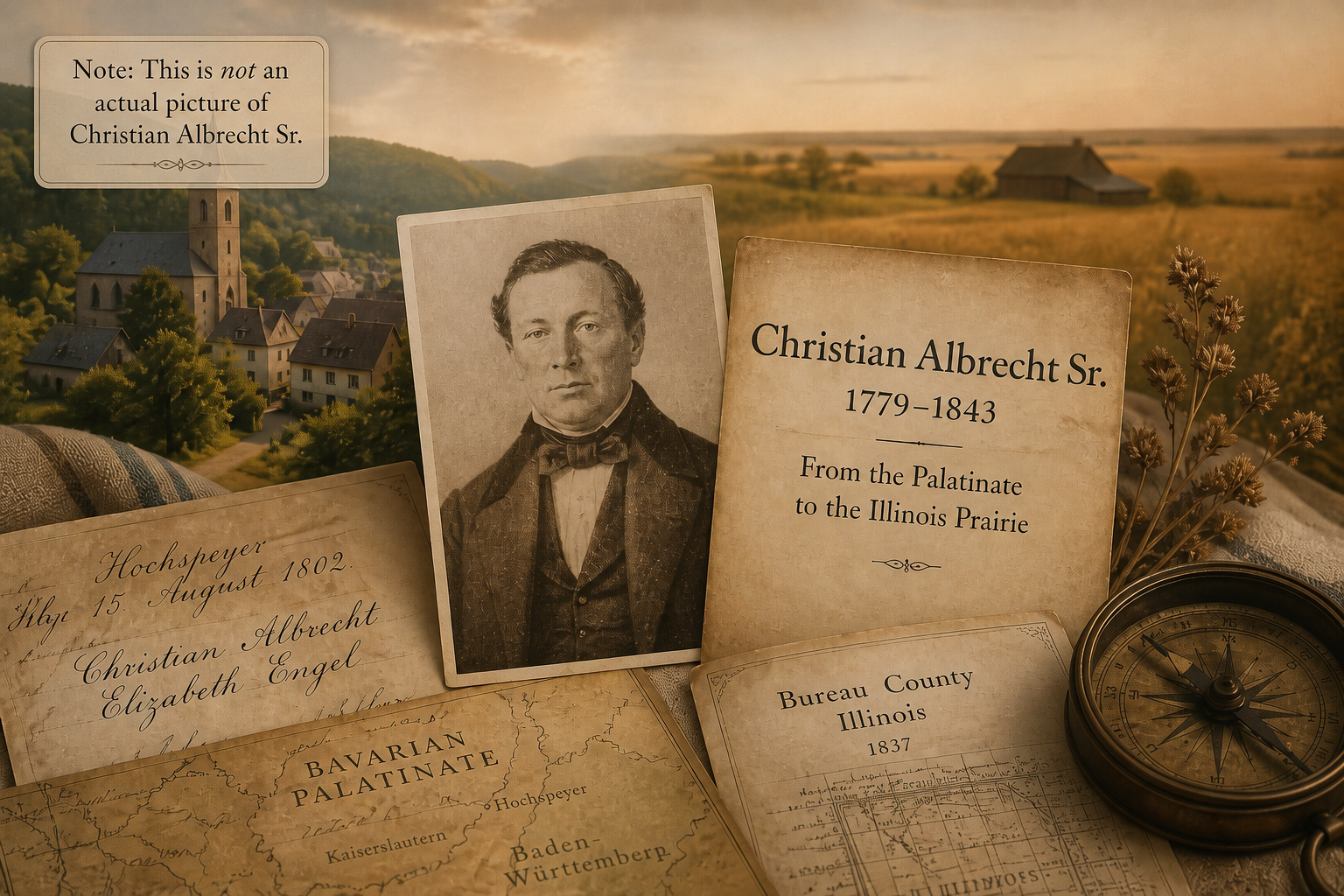
Christian Albrecht Sr. was born 4 December 1779 in Hermersbergerhof, in the Bavarian Palatinate, the first child of Johannes Albrecht and Magdalena Gingerich. His early world was one of wooded hills, village communities, church records, and shifting political borders. The nearby Kaiserslautern and Hochspeyer region lies along the Palatinate Forest, an area shaped by farming, forests, and small-town life. Hochspeyer later passed into the French Département Mont-Tonnerre in 1801 and then into the Kingdom of Bavaria in 1815, meaning Christian lived through a time when borders and governments changed around ordinary families.
On 15 August 1802, at age twenty-two, Christian married Elizabeth Engel in Hochspeyer. Elizabeth, daughter of Jakob Engel and Anna Imhof, became his partner in a growing family whose story would eventually stretch from German villages to the prairies of Illinois.

Christian and Elizabeth’s children were born across the German lands during the first decades of the 1800s: Barbara, Jacob, Elizabeth, Peter, John, Katherine, Joseph, Magdalene, and Christian Jr. Their birthplaces—Kaiserslautern, Hochspeyer, Baden-Württemberg, Büdenhof, and Bavaria—suggest a family whose path was not entirely still. Whether those moves reflected work, kinship, opportunity, or necessity, the records show a household living through transition.
By the end of Christian’s life, the family story had crossed an ocean. Christian died on 3 February 1843 in Arispie, Bureau County, Illinois. Bureau County had only been officially founded in 1837, and early settlers there encountered rich prairie land as well as the hardships of frontier settlement. For Christian, who had been born among the forests and villages of the Palatinate, Illinois represented a very different landscape—open prairie, new communities, and a future that many of his children would continue to build.
In my research, the move from the Palatinate to the Illinois prairie is a classic ‘Echoes of Kin’ story. I often see these families arriving in Bureau County just as the land was opening up—bringing their German farming techniques to a soil that was vastly different from the hills of Bavaria. Seeing the Albrechts rooted in Tiskilwa and Princeton for generations shows that they weren’t just looking for land; they were building a permanent anchor for everyone who came after.
Several of Christian and Elizabeth’s children remained deeply connected to Bureau and nearby counties. Jacob died in Princeton; Elizabeth in Tiskilwa; Peter in Macon, Bureau County; John and Joseph in Tiskilwa; and Christian Jr. was buried at Willow Springs Cemetery. Their marriages into the Ringenberger, Zierlein, Burkey, Ackerman, Orendorf, and Gingery families helped root the Albrecht line into the fabric of Illinois community life.

Christian’s life suggests persistence across change: political change in Europe, family growth across several German communities, and finally migration into a young Illinois county. His choices—and perhaps the choices made with Elizabeth—helped shape a family path that carried forward through farms, cemeteries, marriages, and descendants across generations.
His story matters because it reminds us that family history is often built by people whose lives were not famous, but whose decisions changed everything for those who came after. Christian Albrecht Sr. began life in a small Palatinate settlement and ended it on the Illinois frontier. Between those two places lies the quiet courage of movement, family, and becoming.
Sources & research notes: This narrative is based on supplied family data, including birth, marriage, death, cemetery, and family relationship details. Historical context was added for the Palatinate/Hochspeyer region and early Bureau County settlement.
What ancestor in your family helped change the direction of everyone who came after?
Leave a Reply