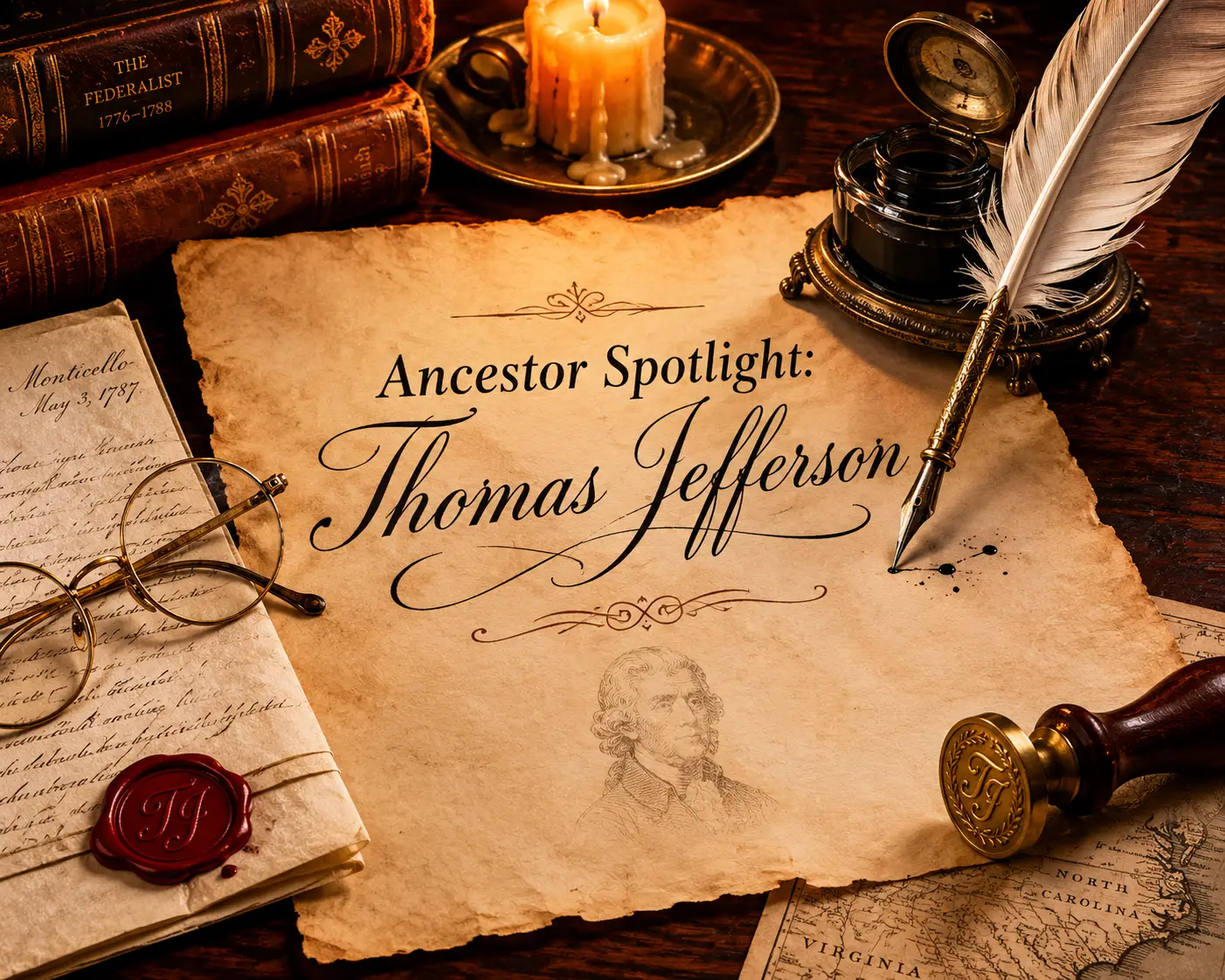
Posted on June 22, 2026 · By Echoes of Kin Genealogy
In the summer of 1776, a thirty-three-year-old Virginia planter sat at a writing desk in Philadelphia as thirteen colonies wrestled with a question that would change history: Should they separate from Great Britain and become an independent nation?
The man was Thomas Jefferson.

Today, as the United States marks its 250th anniversary, Jefferson’s name remains closely linked with a document that continues to shape American identity—the Declaration of Independence. Yet beyond the familiar portrait and famous words was a real person whose life unfolded amid the uncertainties, opportunities, and contradictions of eighteenth-century America.
His story is not only the story of a statesman. It is also the story of a son, husband, father, landowner, scholar, and citizen whose decisions helped influence the course of a developing nation.
His World — Environment, Work & Community
Thomas Jefferson was born on April 13, 1743, in Shadwell, Virginia, a frontier plantation located along the Rivanna River. Colonial Virginia was largely rural, with agriculture serving as the foundation of both the economy and daily life.
As a member of Virginia’s planter class, Jefferson grew up in a society shaped by land ownership, local governance, and the labor of enslaved people. Education was highly valued among wealthy families, and Jefferson benefited from opportunities that allowed him to study classical languages, philosophy, science, and law.
The Virginia of his youth was a world of expanding settlements, political debate, and increasing tensions between colonial interests and British authority. These conditions formed the backdrop against which Jefferson developed his ideas about government, rights, and public service.
Life Timeline Through Records

Records show that Jefferson was the third of ten children born to Peter Jefferson and Jane Randolph Jefferson. His father was a surveyor, planter, and local leader whose landholdings provided opportunities for the family’s future generations.
Jefferson attended the College of William & Mary in Williamsburg, where he studied under influential mentors and developed interests that would remain with him throughout his life: history, architecture, agriculture, science, and political philosophy.
After completing legal studies, he established himself as an attorney and soon entered public service. His political career advanced rapidly during a period of growing colonial unrest.
In 1772, Jefferson married Martha Wayles Skelton, a young widow from a prominent Virginia family. Together they established their household at Monticello, the mountaintop estate Jefferson spent decades designing, expanding, and refining.
The records of Jefferson’s life become increasingly abundant as he entered public office. He served in Virginia’s legislature, represented Virginia in the Continental Congress, helped draft the Declaration of Independence in 1776, served as governor of Virginia during the Revolutionary War, and later held numerous national positions, including Secretary of State, Vice President, and eventually the third President of the United States.
Throughout these years, correspondence, government documents, land records, and personal papers reveal a man deeply engaged with public affairs while also managing extensive agricultural and family responsibilities.
Challenges, Turning Points, & Resilience
Like many lives preserved in historical records, Jefferson’s was marked by both achievement and hardship.
The American Revolution transformed the world in which he lived. Political uncertainty, military conflict, and economic disruption affected families throughout the colonies, including Jefferson’s own household.
A significant personal loss occurred in 1782 when his wife Martha died after ten years of marriage. Contemporary accounts and family records indicate that her death deeply affected the family and altered the course of Jefferson’s personal life.
Jefferson also faced ongoing financial challenges. Despite his public prominence, records show that debt remained a persistent concern throughout much of his adult life. Agricultural fluctuations, inherited obligations, and the costs associated with maintaining large estates contributed to financial pressures that continued long after his presidency.
In my own work tracing the deep roots of families who left the early clearances of Ohio to push northward into the timber camps of mid-century Michigan, I see these exact same economic battles playing out on a different scale. An ancestor might not have been managing a massive Virginia plantation, but their land records show the identical vulnerability to crop failures, fluctuating market prices, and inherited family debts that forced them to mortgage the farm or pack up a wagon to start over in a new territory. Whether you are looking at a President’s estate ledger or a homesteader’s simple tax receipt, financial uncertainty wasn’t a failure—it was the primary engine that drove migration across the American landscape.
These challenges remind us that even individuals remembered for extraordinary public accomplishments navigated the ordinary difficulties of family responsibilities, loss, and economic uncertainty.
Public Service During the Revolutionary Era
Although Jefferson is often associated with the Revolutionary War, his contribution came primarily through political leadership and public service rather than military command.
His most enduring role emerged in June 1776 when the Continental Congress appointed a committee to prepare a declaration explaining why the colonies sought independence. Jefferson was selected to draft the initial text.
The resulting Declaration of Independence announced principles that would resonate far beyond the Revolutionary era. While the document reflected the collaborative work and revisions of Congress, Jefferson’s draft provided much of its language and structure.
His service continued after independence through diplomatic assignments in France, leadership within the early federal government, and two presidential terms from 1801 to 1809.
The records of this service reveal a life devoted to shaping institutions that would outlast his own generation.
Character & Legacy — Connecting Generations
Family historians often seek to understand not only what an individual did, but how their choices influenced those who followed.
Jefferson’s life suggests a commitment to learning, public engagement, and intellectual curiosity. His extensive correspondence, personal library, architectural designs, and scientific interests reveal a person who believed knowledge could improve both individuals and society.
His path helped shape the development of the United States during its earliest decades. Decisions made by Jefferson and his contemporaries influenced government, education, territorial growth, and civic life for generations afterward.
At the same time, modern historians continue to examine the complexities and contradictions within his life, including the realities of slavery at Monticello. These documented facts remain an essential part of understanding Jefferson as a complete historical figure rather than a simplified symbol.
For family historians, his story offers a reminder that every life contains both accomplishments and complexities. The historical record often preserves evidence of both.
Reflection — Why His Story Still Matters
As America celebrates 250 years since the Declaration of Independence, Thomas Jefferson’s story invites us to consider the enduring influence of those who came before us.
Most ancestors never drafted founding documents or held public office. Yet their choices, sacrifices, migrations, occupations, and family commitments shaped the paths their descendants would follow.

Jefferson’s life demonstrates how one generation can leave a legacy that extends far beyond its own time. Whether remembered through national history or family history, each life becomes part of a larger story carried forward by those who follow.
The work of genealogy reminds us that history is ultimately personal. Behind every record stands a real individual whose life contributed, in ways large or small, to the world we inherit today.
As we reflect on America’s 250th birthday, perhaps it is also worth asking: Which ancestor in your own family helped shape the direction of generations that followed?
Sources & Research Notes
To reconstruct a complete life with historical integrity, a narrative must rely on a diverse web of independent records rather than a single biography. This narrative was developed from documented historical sources, including:
- Vital & Domestic Roots: Birth, marriage, and family records
- Personal Reflections: Correspondence and private papers
- Geographic Footprints: Colonial Virginia land and estate records
- Public Footprints: Continental Congress, diplomatic, and presidential records
- Scholarly Analysis: Monticello historical collections and published peer-reviewed research
Leave a Reply