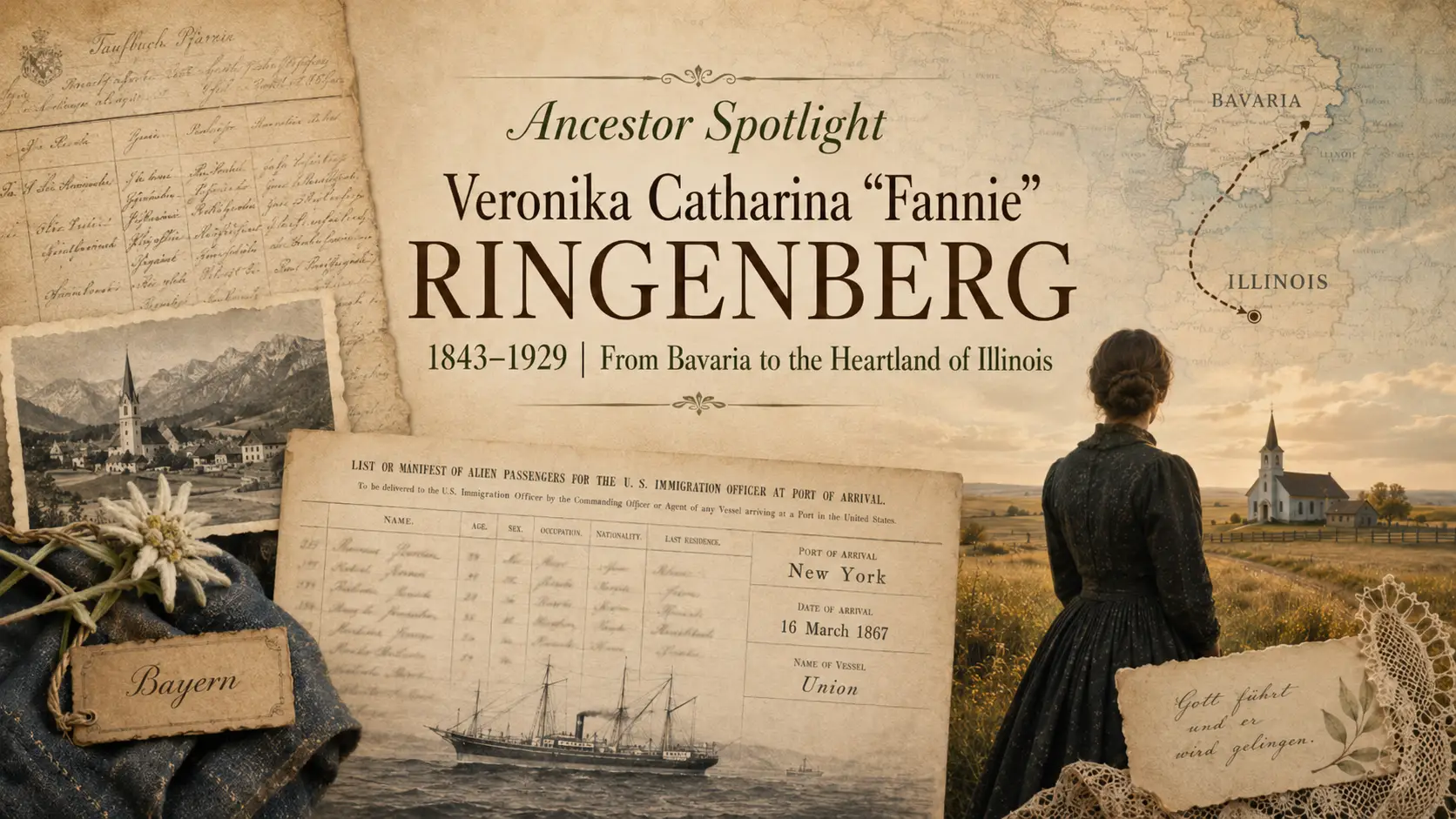
From Bavaria to the Heartland of Illinois
Posted on May 29, 2026 · By Echoes of Kin Genealogy
A Daughter of Bavaria
On 28 August 1843, in Bavaria (Bayern), Germany, Veronika Catharina Ringenberg was born the second child of Christian Ringenberg and Marie Burkey. Parish records situate her early life in Karlskron, a rural Bavarian community shaped by agriculture, Catholic faith, and tightly woven kinship networks.
She grew up alongside six siblings: Christian Joseph, John, Jacob, Peter W., Katharena, and Mary. Mid-19th-century Bavarian village life revolved around the agricultural calendar and parish rhythms. While we do not have personal writings from Veronika, the historical setting helps us understand the environment that formed her early years.
At just seventeen years old, she married Christian John Gingerich on 26 January 1861 in Karlskron (FHL Film 816431, Ref ID P96). The record anchors her in a specific place and moment — a young bride beginning her adult life in the village where she was born.
“From a Bavarian parish to the prairies of Illinois, her life traced the path of 19th-century immigration — one record at a time.”

Crossing an Ocean
On 16 March 1867, passenger arrival records show Veronika arriving in New York aboard the ship Union. This documented journey marks a profound turning point.
The mid-1800s saw many Bavarian families leave due to limited land inheritance and economic pressure. Illinois, in particular, drew German-speaking immigrants seeking farmland and opportunity. Established immigrant communities provided language, church continuity, and cultural familiarity.
Sometime between 1865 and 1869, Veronika and her family settled in Illinois. By the 1870 census, she was residing in Wheatland, Bureau County (Post Office: Lone Tree). Her world had shifted from European village fields to the expanding agricultural heartland of America.

Building a Life in Illinois
Marriage and Motherhood
From her first marriage to Christian John Gingerich came several children:
- Katharina Marie Gingerich (1862–1929)
- Christian Gingerich (b. 1864)
- Barbara Ellen Gingerich (1865–1952)
- Mary Gingerich (b. 1869)
- Peter (documented in family records)
The birthplaces recorded for her older children confirm the family’s transition from Bavaria to Illinois within just a few years.
In 1877, she married Anthony “Anton” Smith in Wheatland, Bureau County. Together they had four children:
- Lena Emma Smith (1876–1947)
- Emma E. Smith (1880–1911)
- Alvin Anton Smith (1883–1971)
- Lydia C. Smith (1886–1975)
The 1900 census, taken while she lived in Morton, Tazewell County, records that she had given birth to eight children, seven of whom were living at that time. In a single census column, we glimpse both abundance and loss.
“Eight children born. Seven living in 1900. One small census notation that quietly reflects a mother’s full life.”

Later Years and New Beginnings
At age fifty-one, Veronika married Christian Eigsti on 8 April 1895 in Macon, Bureau County, Illinois (Vol. L, p. 51). No children were born of this marriage.
By 1910, census records show her living in Tremont, Tazewell County, listed as widowed and residing in the household of one of her children. The designation “Mother” marks a generational shift — from immigrant daughter to matriarch within an American-born family.
These records reflect resilience shaped not by dramatic headlines, but by steady adaptation: remarriage, relocation, and continued presence within her children’s households.
Her Final Rest

Veronika died on 1 June 1929 in Olio Township, Woodford County, Illinois, at age 86 (Death Certificate #1020106; FHL Film 1643316). She was buried on 4 June 1929 in Willow Springs Cemetery in Tiskilwa, Bureau County, Illinois (Row 1, 40B).
Her burial in Bureau County places her to rest in the same region where she had spent much of her American life — among the communities shaped by immigrant farmers and their families.
“Born in a Bavarian kingdom. Laid to rest in the Illinois prairie. Her lifetime spanned worlds.”
Character & Legacy
While the records do not reveal her voice, her documented choices suggest endurance and adaptability:
- Transatlantic migration
- Three marriages over three decades
- Raising eight children across changing households
- Remaining rooted in central Illinois communities
Her life bridged two continents and multiple generations. Through her children — who settled in Illinois and beyond — her legacy extended into the 20th century.
She lived through extraordinary historical shifts: European monarchy, American Civil War era, industrial expansion, and the eve of the Great Depression. Yet her story is preserved not in headlines, but in parish entries, passenger lists, census pages, and a death certificate.
Why Her Story Still Matters
Veronika Catharina “Fannie” Ringenberg’s life reminds us that family history is built not only from famous names, but from steady, persistent lives.
Each document preserves a fragment. Together, they reveal a woman who crossed an ocean, rebuilt her household more than once, and anchored generations that followed.
Her story invites us to look carefully at the ordinary — because it is there that legacy lives.
Who in your own family crossed a boundary that changed the direction of generations to come?
Research Notes & Sources
This narrative is grounded in documented records, including:
- Bavarian parish and civil records (Karlskron)
- Passenger arrival record, Ship Union (New York, 16 March 1867)
- U.S. Federal Census records (1870, 1880, 1900, 1910)
- Illinois marriage records (Bureau and Macon Counties)
- Illinois death certificate (1929; FHL Film 1643316)
- Willow Springs Cemetery burial record, Tiskilwa, Illinois
At Echoes of Kin Genealogy, we honor each ancestor through careful research, contextual history, and compassionate storytelling — because every life deserves to be remembered with dignity.
Leave a Reply