Posted on October 16, 2026 · By Echoes of Kin Genealogy
KEY TAKEAWAYS
- County histories can reveal the community surrounding an ancestor. Local biographies, settlement accounts, church histories, and descriptions of everyday life may help explain the circumstances in which a family lived.
- Published family sketches are valuable clues, but they are not automatically reliable evidence. Dates, relationships, migration stories, and claims about family origins should be checked against contemporary records.
- The greatest discoveries sometimes appear outside your ancestor’s own name. Neighbors, relatives by marriage, local institutions, and community events can provide the context needed to understand a family’s history.
There is something quietly remarkable about opening a county history published more than a century ago.
The pages may be yellowed, the binding worn, and the language more formal than anything we would use today. Somewhere between descriptions of early settlements, township boundaries, churches, businesses, and prominent residents, there may be a familiar surname.
Perhaps it belongs to your great-great-grandfather.
You have already found him in census records. You know approximately when he was born, where he lived, and the names of his wife and children. A land deed establishes that he purchased forty acres. A death certificate provides the date his life ended.
But those records leave questions.
What was the community like when he arrived? Why did families settle there? Who were his neighbors? What opportunities, hardships, and changes shaped the place he called home?
A county history may not answer every question. Sometimes it raises entirely new ones.
Still, it offers something genealogists are often searching for without quite realizing it: a way to place an ancestor’s documented life within the larger story of a community.
And occasionally, tucked into a paragraph written for an entirely different purpose, it preserves a family detail that has disappeared from every other source we have examined.
What Exactly Is a County History?
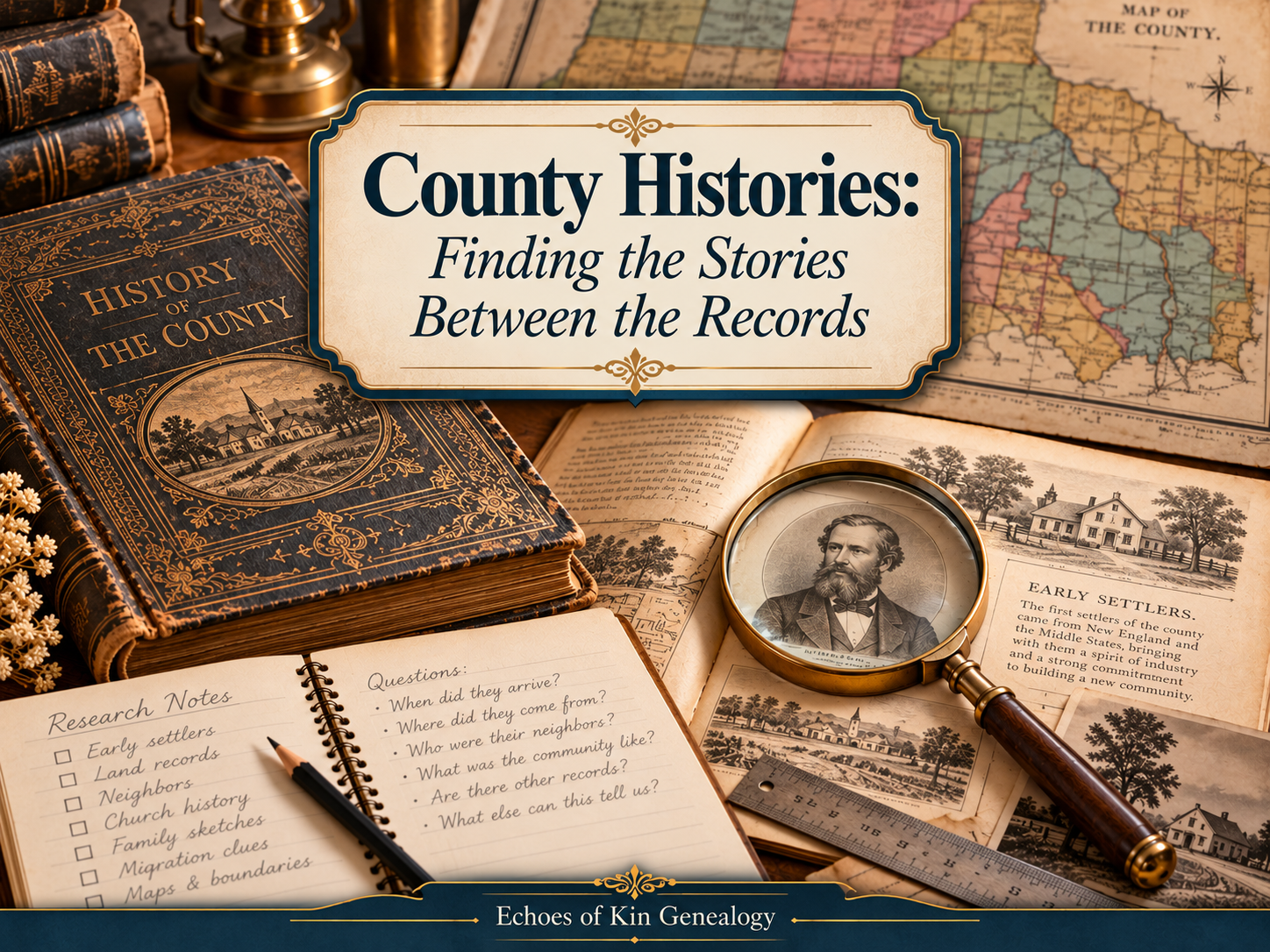
County histories are published accounts documenting the development of a particular county or region. Many American examples appeared during the nineteenth and early twentieth centuries, particularly around the nation’s centennial era and subsequent decades.
Their contents vary considerably. Some are substantial volumes running hundreds of pages, while others are shorter commemorative publications assembled for county anniversaries or local celebrations.
Depending on the publisher and purpose, a county history might include:
- Accounts of early settlement and migration into the region.
- Descriptions of townships, villages, and changing boundaries.
- Histories of churches, schools, cemeteries, and civic organizations.
- Biographical sketches of residents and local families.
- Information about agriculture, manufacturing, transportation, and local businesses.
- Accounts of military service, epidemics, disasters, and significant community events.
- Portraits, illustrations, maps, and occasionally photographs of homes or farms.
Not every volume contains all these features. A book focused primarily on prominent citizens may provide extensive biographies but relatively little information about ordinary working families.
Other histories devote considerable attention to local institutions and settlement patterns, making them useful even when an ancestor is never mentioned by name.
That distinction matters.
A county history can contribute to your research even when it contains no biography of your family.
Why County Histories Matter in Family History Research
Genealogists spend a great deal of time establishing relationships and documenting events.
We identify parents, locate marriages, compare census households, and follow property transactions. Each record contributes something important, although the information is often limited to the purpose for which that record was created.
County histories can help connect those separate pieces of evidence to the world in which our ancestors lived.
Imagine discovering that your ancestor was a blacksmith in an Ohio township in 1870.
The census confirms his occupation. That is useful information, but it tells us little about his daily circumstances.
A county history might describe the construction of a railroad through the township during that period. It could identify a nearby agricultural community, mention the establishment of a wagon-making business, or describe how local roads connected farms to market towns.
None of that proves your ancestor worked for the railroad or supplied a particular business.
It does, however, help you understand the local economy in which his trade existed. It may also suggest additional records worth investigating.
That is the difference between using historical context responsibly and allowing an appealing narrative to outrun the evidence.
A Name in a Book Can Open an Unexpected Door
One of the most useful features of many county histories is the biographical sketch.
These sketches often contain information not readily available in standard genealogical records.
A biography might identify a resident’s parents, mention the family’s earlier residence in another state, describe military service, or name a spouse’s family.
Consider this fictional example, created to illustrate a research method:
ILLUSTRATIVE COUNTY HISTORY EXCERPT
“In the spring of 1854, Jonathan Mercer came to Franklin Township from Washington County, Pennsylvania, accompanied by his wife, Margaret, and their three young children. He purchased land along the eastern branch of Mill Creek and engaged in farming for the remainder of his life.”
Fictional passage for educational purposes, not a quotation from an actual county history.
At first glance, this is a simple family biography.
Look more closely, however, and several research possibilities emerge.
The statement supplies a possible migration year and an earlier county of residence. It identifies a wife by her given name, suggests that at least three children were born before the move, and describes the general location of a farm.
Each detail can guide further research.
The 1850 census in Washington County, Pennsylvania, might reveal a matching household. Land records in the destination county could help establish when Jonathan acquired property. Tax lists might narrow his arrival date, while local maps could identify the creek and nearby landowners.
The biography is not proof of those claims by itself.
Its value lies in providing specific statements that can be tested against other evidence.
Reading Between the Lines of a County History
A county history becomes particularly useful when we stop treating it as a collection of names and begin examining how the community functioned.
1. Migration Patterns May Explain Why a Family Appeared Somewhere New
Families rarely moved without circumstances influencing their decisions.
Economic opportunity, available land, religious communities, employment, family connections, and changing transportation routes all played roles in historical migration.
Suppose your research places an ancestor in western Pennsylvania in 1840 and northern Illinois by 1860.
A county history might describe the arrival of settlers from Pennsylvania during the 1840s and 1850s. It may identify particular townships established by migrants from the same region.
That information does not establish why your ancestor moved.
It can, however, suggest a useful question: Did this family migrate as part of a larger network of relatives or neighbors?
Examine the households appearing near your ancestor in both locations. Look for recurring surnames in marriage records, deeds, probate files, and church registers.
Sometimes the migration of one family becomes easier to understand when we recognize that several connected households traveled along similar paths.

2. Churches and Schools Can Reveal Community Connections
Religion and education often occupied important places in nineteenth-century community life, although participation and access varied widely.
County histories may describe the founding of congregations, construction of schoolhouses, or arrival of religious leaders.
Imagine finding an ancestor in a township where the county history identifies a German-speaking congregation established in the 1860s.
If other evidence suggests that your family belonged to that religious community, the history might point you toward baptismal registers, marriage records, burial records, or surviving congregational archives.
It may even mention a congregation that later merged, relocated, or changed its name.
A school history can offer similar clues. Descriptions of school districts may help establish where a family lived and where additional local records could have been created.
Of course, proximity to a church or school does not prove attendance or membership.
The history provides a research lead. Membership rolls, registers, school records, or other contemporary evidence must supply the connection.
3. Local Events Can Give Meaning to a Family Timeline
Consider a family that appears in the 1880 census but has disappeared from its familiar township by 1900.
Perhaps the parents relocated. Perhaps their adult children established households elsewhere.
A county history might describe a devastating flood, the closing of a major employer, or a prolonged period of agricultural difficulty.
Could those events have influenced the family?
Possibly.
But the responsible approach is to establish the timeline before making that connection.
Did the event occur before the family’s departure? Is there evidence that their property or livelihood was affected? Do newspapers, tax records, or land transactions support a relationship between the event and the move?
A useful family narrative might explain that the family lived in the county during a documented period of economic hardship.
It should not claim that hardship forced them to leave unless the available evidence supports that conclusion.
Historical context is most meaningful when readers can see where the documented facts end and the unanswered questions begin.
The Neighbor Who May Hold the Missing Clue
One of the most overlooked strategies in county history research is reading biographies of people who lived near your ancestor.
Your family may not have been considered prominent enough to receive a published sketch.
Their neighbors might have been.
A neighboring farmer’s biography could identify a former hometown, mention a shared church, or describe the settlement of several related families.
That information may become useful when compared with land deeds, census records, and marriage witnesses.
This approach is closely related to FAN Club research, a method associated with genealogist Elizabeth Shown Mills. FAN stands for Friends, Associates, and Neighbors.
The principle is straightforward: an ancestor’s identity and relationships may be clarified by studying the people connected to them.

An Illustrative Research Scenario
Suppose you are researching a woman named Sarah Whitcomb, who appears with her husband in an 1870 Indiana census.
You know her married surname, approximate age, and the names of her children. Her maiden name remains uncertain.
A county history published in 1888 contains no biography of Sarah or her husband.
It does, however, include a lengthy sketch of a nearby resident, Henry Lawson, who reportedly migrated from the same Ohio county as several families in Sarah’s Indiana neighborhood.
The biography mentions that Henry’s sister married a man named Whitcomb.
That statement does not prove Sarah’s maiden name or establish her relationship to Henry.
But it offers a lead worth pursuing.
You could examine Ohio marriage records, Indiana deeds, probate records for the Lawson family, and the identities of witnesses appearing in relevant documents.
The breakthrough, if one occurs, would come from correlating the records.
The county history simply helped you recognize a possible connection.
This scenario is fictional and is included to demonstrate the research process.
A Word of Caution: County Histories Were Not Always Neutral

For all their value, county histories require careful evaluation.
Many nineteenth-century county histories were commercial publishing projects. In some cases, residents or families paid to have biographical sketches or portraits included.
The details might have been supplied by the subjects themselves, their relatives, or individuals working for the publisher.
Some information was gathered long after the events described.
A person remembering a migration from forty years earlier might confuse the year. An adult child providing a biography of a deceased parent might misunderstand an earlier marriage or ancestral birthplace.
Certain sketches emphasized social standing, wealth, military service, or distinguished ancestry.
Other residents received little attention.
Women were frequently described primarily through their relationships to husbands and fathers. Black residents, Indigenous communities, immigrant laborers, and poorer households were often underrepresented, stereotyped, or omitted entirely, depending on the publication.
These limitations affect what the books preserve and whose experiences they recognize.
Absence from a county history is not evidence that a person lacked importance within the community.
Common Claims That Deserve Verification
| County history statement | Records worth checking |
| “Born in Virginia in 1825” | Census records, family Bible entries, vital and church records |
| “Came to the county in 1852” | Land deeds, tax lists, census records |
| “Married Mary Thompson” | Marriage records, probate files, church registers |
| “Served in the Civil War” | Military service and pension records |
| “Son of a Revolutionary soldier” | Pension files, probate, land and lineage evidence |
| “One of the earliest settlers” | Contemporary tax lists, deeds, and local government records |
The goal is not to dismiss a published history.
It is to understand the source well enough to use it appropriately.
A biography may contain accurate first-hand recollections alongside inherited family traditions or editorial embellishments. Each claim deserves evaluation according to its source, informant, timing, and corroboration.
How to Find County Histories Online
Fortunately, many county histories have been digitized.
Some can be read without charge, searched by keyword, or downloaded for offline research.
Here are several worthwhile starting points.
A large collection of digitized books, including county histories, local biographies, directories, and commemorative publications. Search by county name, state, and terms such as history or biographical.
Search digitized family and local history publications. Some materials have access restrictions or require a free account.
An important source for historical publications, including county histories and regional studies. Full-view availability depends on the work’s access status.
Useful for locating historical volumes through title searches and full-text searching where available.
State libraries, historical societies, university special collections, and local genealogical societies may also maintain digitized or physical copies.
Do not overlook a county library’s local history room. Some institutions hold annotated copies, surname indexes, or companion collections that never appeared online.
Search Beyond the Obvious Title
A publication may not use the exact phrase county history.
Try combinations such as:
- “[County Name] County” “[State]” history 1880
- “[County Name]” biographical record
- “[County Name]” portrait and biographical album
- “[County Name]” historical and genealogical
- “[County Name]” pioneers settlers
If a surname search produces nothing, search the township, nearby village, church, or another known family name.
Also try alternate spellings and initials.

Digitized books frequently rely on optical character recognition, commonly called OCR, to make scanned pages searchable. Old typefaces, damaged pages, and faded printing can produce errors.
A missing search result does not necessarily mean the name is absent.
When possible, consult the original page image and the book’s printed index rather than relying exclusively on automated text.
A Practical Method for Researching County Histories

Finding a promising volume is only the beginning.
The next step is turning what you read into a manageable research process.
County History Research Workflow
1. Locate the history
Search the county, state, township, and relevant publication dates.
2. Search names and communities
Include surname variants, neighbors, institutions, and local places.
3. Extract individual claims
Separate stated facts, historical descriptions, and interpretations.
4. Correlate with other evidence
Check contemporary records and document conflicts or uncertainty.
5. Preserve the discovery
Record the source citation, page image, findings, and next research steps.
Keep a Research Log for Every Useful Discovery
It is tempting to save a screenshot of a promising paragraph and move on.
Unfortunately, a screenshot without a citation can become a mystery of its own six months later.
Record the title of the publication, author or compiler, publisher, publication year, and relevant page numbers.
Include the digital repository, stable link when available, and the date you accessed the item.
Most importantly, write down exactly what the passage says and what it does not establish.
A research log entry might look like this:
Example Research Log Entry
FICTIONAL EXAMPLE
| Field | Entry |
| Source | History of Franklin County (illustrative title) |
| Publication | 1892 |
| Page | 347 |
| Subject | Jonathan Mercer |
| Claim | Migrated from Washington County, PA, in 1854 |
| Assessment | Published account; informant not identified |
| Next step | Examine 1850 Pennsylvania census and destination land records |
This kind of documentation makes it easier to revisit your reasoning, particularly when a later record contradicts an earlier assumption.
Turning Historical Context Into a Meaningful Ancestor Story
County histories are particularly helpful when writing ancestor profiles, family narratives, and research reports.
They allow us to move beyond a chronological sequence of events without inventing personal experiences.
Suppose a family lived in an agricultural township during the 1870s.
A county history describes the establishment of a local gristmill, the expansion of the road network, and the founding of a nearby church.
If those details are relevant to the family’s documented residence, they can help readers picture the community.
But the wording matters.
Instead of writing:
“Every Sunday, the family traveled by wagon to the little church, where they gathered with their neighbors after a long week of farm labor.”
We might write:
“By the 1870s, the township supported a growing agricultural community. A county history published later in the century described the establishment of a local gristmill and a nearby congregation. Although no surviving evidence has yet established the family’s participation in that church, these accounts help document the institutions and services available in the area during their residence.”
The second version is less dramatic, but it offers something more enduring.
It respects the difference between documented community history and an individual’s unrecorded experience.
We can still write with warmth. We can describe the landscape, identify local changes, and explain the circumstances in which people lived.
We simply need to let the evidence determine how closely we can connect those details to a particular ancestor.
What If Your Ancestor Was Never Mentioned?
This is common, and it should not discourage you.
Many people whose work sustained their communities received little attention in published histories.
A domestic worker might appear in census records but never in a county biography. The same may be true of a tenant farmer, a laundress, a railroad laborer, or a woman who raised a large family while managing a household.
Their lives were no less significant.
For these ancestors, county histories may be most valuable as sources of local context rather than personal biography.
Look for the development of neighborhoods, changes in transportation, descriptions of industries, and accounts of institutions that served the community.
Then turn to other sources to recover individual experiences.
City directories, newspapers, tax records, probate files, employment records, church registers, and local manuscript collections may preserve details the published county history overlooked.
💡 Michelle’s Pro-Tip: The “Patrons’ Directory & Atlas” Backdoor
“If your ancestor didn’t pay for a lengthy biography in the county history, don’t close the book just yet! Turn straight to the back of the volume or check the companion County Illustrated Atlas (plat book) published during the same era. Many publishers included a modest, fine-print ‘Patrons’ Reference Directory’ at the end of the book. In that single back table, you will often find everyday tenant farmers, blacksmiths, and laborers listed with their exact section number, birth year, state of origin, and the exact year they arrived in the county—all without them ever paying for a full-page sketch!”
Citing County Histories Correctly
A useful discovery deserves a citation that allows someone else to find the same passage.
For a digitized county history, the citation should generally identify the original publication and the online version consulted.
For example, the elements may include:
Author or compiler, Title of County History (Place of publication: Publisher, Year), page number; digital image, Repository (URL : accessed date).
The exact format depends on the citation style you use and the nature of the source.
When working with a scanned volume, distinguish between the book’s printed page number and the image number assigned by the website.
They may not match.
If a biography occupies pages 214 through 216, cite the particular page containing the statement you used, or the relevant range if necessary.
A good citation preserves the path back to the evidence.
It also makes it easier for future researchers, including members of your own family, to understand where a story originated.
Five Questions to Ask When You Open a County History
Before moving on to the next record collection, consider these questions:
- Who created this history, and when? Was it written close to the events described, or decades later?
- Whose voices are represented? Were biographies submitted by residents, compiled from earlier publications, or assembled from unidentified sources?
- What does the history reveal about the community? Consider migration, settlement, occupations, institutions, and local changes.
- Which statements can I verify? Identify claims about dates, relationships, residences, and personal experiences that can be tested.
- Who else should I research? Look for neighbors, relatives by marriage, witnesses, business partners, and community leaders connected to the family.
These questions help transform an interesting historical book into a purposeful research source.
The Stories Between the Records
There is a particular satisfaction in finding an ancestor’s name printed in an old county history.
For a moment, someone who existed only as a line in a census or a signature on a deed appears in a different setting.
Perhaps the biography identifies the county from which the family migrated. Perhaps it names a previously unknown relative.
Sometimes the discovery is much quieter.
You read about the founding of a small town, the development of its farms, or the arrival of families who settled along a particular creek. Then you return to your ancestor’s land record and recognize one of those place names.
The record itself has not changed.
Your understanding of it has.
That is one of the gifts of local history. It reminds us that our ancestors did not live as isolated entries in government registers. They belonged to communities that changed around them, influenced their opportunities, and left traces in records we may not yet have considered.
We may never recover their private thoughts or fully understand the choices they made.
But by carefully studying the places they lived, the people around them, and the surviving evidence, we can tell a fuller story without pretending to know what history has not preserved.
Sometimes the next chapter of a family’s history is waiting in a book that was never written specifically about them.
And sometimes the most meaningful discovery is not another name or date, but a clearer understanding of the world an ancestor once called home.
Historical records give us the skeleton of an ancestor’s life; local histories help put flesh on the bones. When you read the landscape and the neighbors alongside the records, you recover not just a name, but the world they lived in.
Warmly,
Michelle Bruner
Genealogist & Founder, Echoes of Kin Genealogy
Continue Your Family History Journey
Have you ever found an ancestor mentioned in an old county history? Or discovered something about a community that changed the way you understood your family’s story?
I’d love to hear what you found.
At Echoes of Kin Genealogy, I believe family history is about more than collecting records. It is about examining the evidence, understanding the communities our ancestors belonged to, and preserving their stories with care.
If you’re trying to move beyond names and dates or need help locating historical sources that may hold the next clue, explore my genealogy research services.
Visit Echoes of Kin Genealogy to learn more, and subscribe to the blog for practical research guidance, historical context, and new ways to explore your family’s past.
Because every family has a history, and every carefully documented discovery helps preserve it.
Leave a Reply