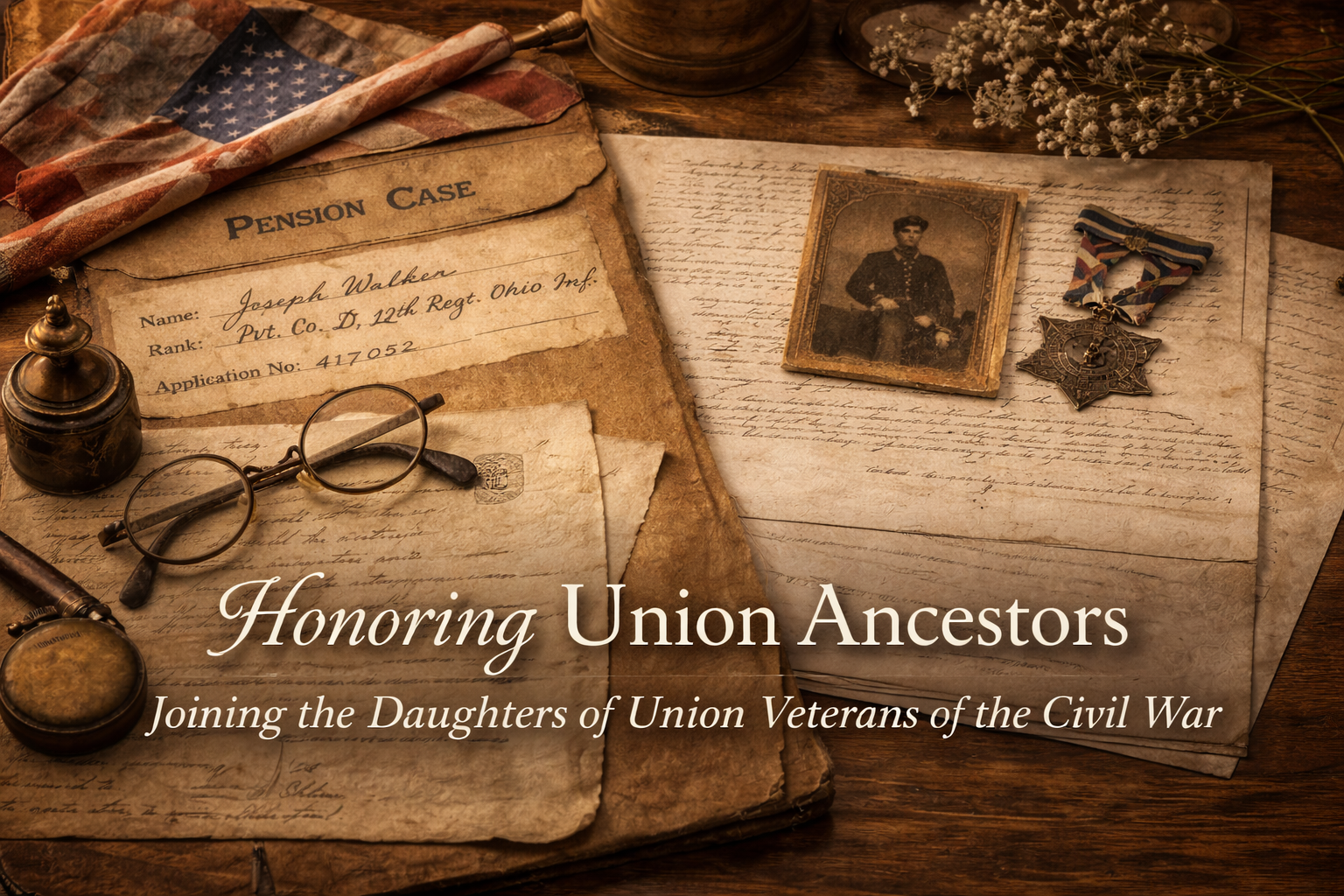
Joining the Daughters of Union Veterans of the Civil War
Posted on March 23, 2026 · By Echoes of Kin Genealogy
There is something quietly powerful about seeing an ancestor’s name written on a Civil War service record. The ink has faded. The paper has softened at the folds. And yet the life behind that record feels startlingly close.
A few years ago, I sat at my desk with my third-great-grandfather’s pension file spread open beside me. I had known, in a general way, that he “served in the war.” But reading the affidavit from a neighbor who remembered him coming home with a limp, and the deposition from his widow explaining how illness followed him into old age, shifted something in me. He was no longer a footnote in a family tree. He was a person who had endured.
For many descendants of Union soldiers, that moment of recognition becomes the beginning of something deeper. Sometimes, it leads to membership in the Daughters of Union Veterans of the Civil War.
What Is the Daughters of Union Veterans of the Civil War?
Founded in 1885 as an auxiliary to the Grand Army of the Republic, the Daughters of Union Veterans, often abbreviated DUVCW, is a lineage society for women who can prove direct descent from a Union veteran of the Civil War.
Membership is not based on distant admiration. It rests on documentation. Applicants must demonstrate lineal descent from a soldier, sailor, or marine who served honorably in the Union forces between 1861 and 1865.
Today, the organization focuses on:
- Preserving Union veterans’ graves and memorials
- Supporting historical education about the Civil War
- Encouraging genealogical research
- Participating in commemorative ceremonies and patriotic events
At its heart, though, it is about remembrance. Not abstract remembrance, but specific, named remembrance.
Why This Matters in Family History
Genealogy often begins with curiosity. Who were they? Where did they live? When did they arrive?
But Civil War research can feel different. The war touched nearly every American family in some way. According to the National Park Service, over 2 million men served in Union forces. That is not a statistic floating in space. It is millions of sons, brothers, fathers.

When you uncover a Union ancestor, you are not just adding a military line to your tree. You are stepping into a national story that shaped citizenship, freedom, and family survival.
Joining an organization like DUVCW can:
- Anchor your research in a supportive community
- Encourage deeper documentation of your lineage
- Offer opportunities to publicly honor your ancestor
- Preserve stories that might otherwise fade
In my own experience, preparing a lineage application forced me to tighten my research. I revisited census records I thought I understood. I ordered a missing death certificate. I double-checked marriage dates that I had once accepted from an online tree without question. The process was humbling. It made me a better genealogist.
How to Qualify for Membership
Step 1: Confirm Your Ancestor’s Service
Start with reliable military records. These may include:
- Compiled Military Service Records
- Pension files
- Regimental histories
- Official rosters
Websites like the National Archives, Fold3, and state archives are often starting points. If your ancestor received a pension, those files can be remarkably rich. They sometimes include affidavits, medical records, and family testimony.

Step 2: Prove Direct Lineal Descent
You will need documentation linking each generation from the veteran to you. This typically includes:
- Birth certificates
- Marriage certificates
- Death certificates
- Census records
If records are missing, alternative documentation may be acceptable, but it must be persuasive and well-supported. This is not about perfection. It is about clarity and evidence.
Step 3: Submit an Application
Applications are reviewed for accuracy and documentation. Some local tents, as chapters are called, offer guidance through the process. Reaching out before submitting can save time and frustration.
The Emotional Weight of Documentation
It can feel bureaucratic at first. Forms. Copies. Citations.
And then, something unexpected happens. As you trace the chain from yourself back to that Union soldier, you see how fragile and remarkable continuity really is. One missed child. One unrecorded marriage. One family that moved and left no paper trail. And yet here you are.
I remember holding my ancestor’s pension index card and thinking how easily his story could have slipped into obscurity. If his widow had not filed for benefits, there would have been far less to find. Her decision to document his service preserved not just financial support, but memory.
That is what lineage societies quietly protect. They create another layer of preservation.
Practical Research Tips Before You Apply
Even if you never join, these steps will strengthen your Civil War research:
- Request the full pension file, not just the index
- Study the regiment’s movements to understand your ancestor’s experience
- Visit the cemetery, if possible, and document the grave marker
- Look for local newspaper obituaries or veterans’ reunion reports
- Review county histories, which often include biographical sketches
Be cautious with online trees. They can be helpful leads, but they are not proof. Always trace the evidence yourself.
A Broader Perspective
Lineage societies are not the only way to honor a Union ancestor. Some researchers prefer quiet remembrance at home. Others volunteer in battlefield preservation or teach local history.
Joining DUVCW is one path among many. It offers structure and community, but it also asks for careful documentation and participation. That may suit some families beautifully. Others may choose a different expression of remembrance.
The key is intention. Are we honoring our ancestors as whole people, not symbols? Are we telling their stories with honesty, including their flaws and limitations?

A Gentle Invitation
If you have a Union ancestor in your tree, perhaps take an evening this month to revisit his record. Read it slowly. Imagine the ordinary morning when he enlisted. Consider the journey home.
And if you feel called to make that remembrance public and documented, explore the Daughters of Union Veterans of the Civil War. Even the application process can become an act of devotion.
Family history is not only about discovering names. It is about stewardship. We are, in a sense, temporary caretakers of their stories.
If you are researching a Union veteran and considering lineage society membership, I would love to hear about your experience. Share your ancestor’s regiment or hometown in the comments. Let’s honor them together, carefully and thoughtfully.
Leave a Reply