Posted on May 25, 2026 · By Echoes of Kin Genealogy
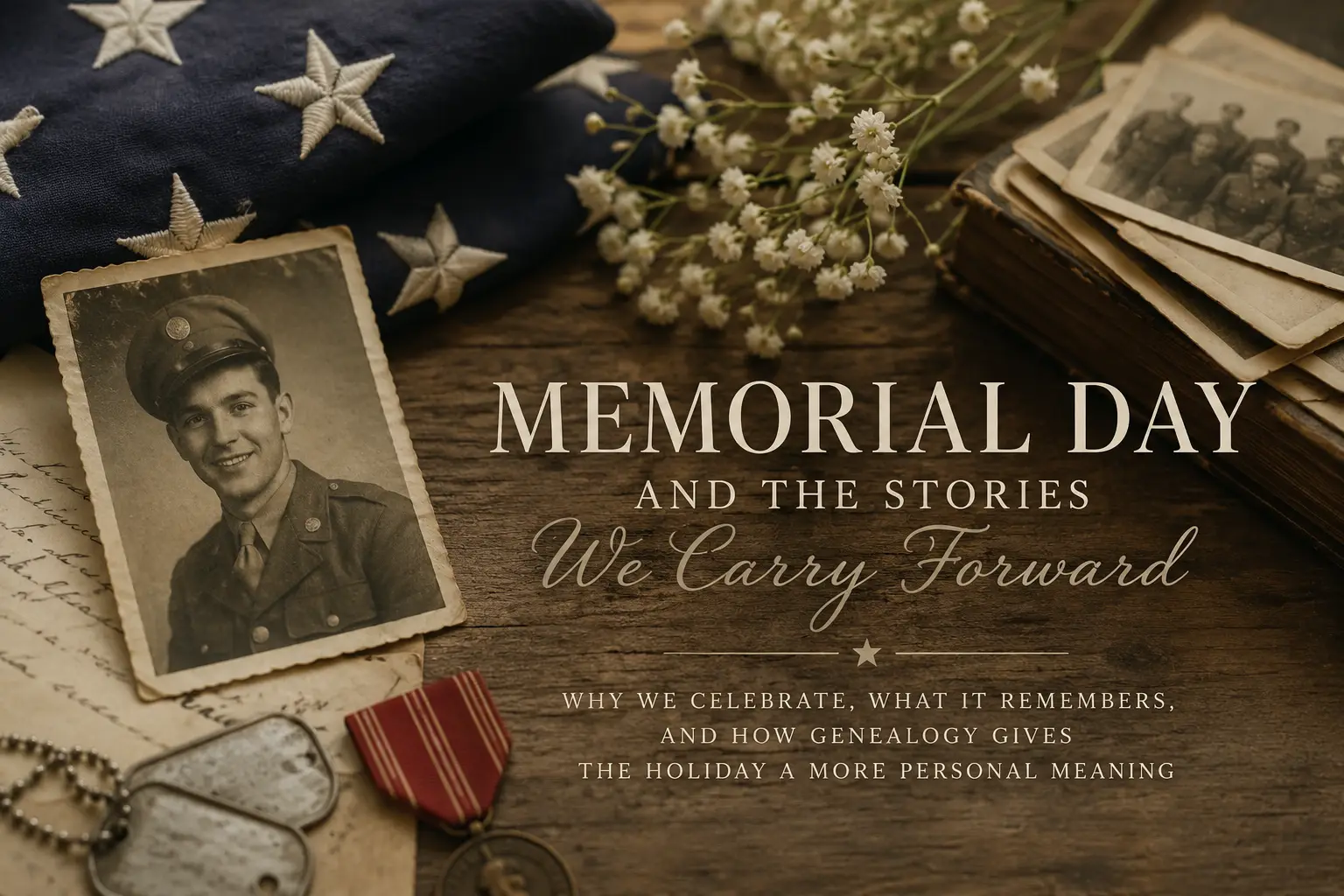
Why we celebrate, what it remembers, and how genealogy gives the holiday a more personal meaning
There is something quiet about Memorial Day that often gets lost beneath the noise of long weekends, crowded stores, and the unofficial beginning of summer. Early Monday morning flags move gently in cemetery rows. Small towns hold parades that feel almost unchanged from decades ago. Someone places flowers beside a military marker because a grandfather once did the same thing for his own father.
For many families, Memorial Day is not only about history in the broad national sense. It becomes deeply personal. A photograph tucked into an album. A folded uniform. A name etched into stone that younger relatives have never heard spoken aloud.
That is part of why this holiday matters so much in genealogy.
Family history reminds us that Memorial Day is not abstract. The people remembered were sons, daughters, brothers, cousins, newlyweds, farmers, teachers, immigrants, and ordinary people whose lives paused in extraordinary circumstances. Researching them often changes the way we understand both the holiday and our own families.

What Is Memorial Day?
Memorial Day is a United States federal holiday dedicated to honoring military personnel who died while serving in the U.S. Armed Forces.
The holiday is observed on the last Monday in May. Its roots stretch back to the years following the American Civil War, when communities gathered to decorate the graves of fallen soldiers with flowers. At the time, many people called it “Decoration Day.”
Over time, the observance expanded to honor American service members who died in all wars and military conflicts.
Today, Memorial Day traditions vary from family to family:
- Visiting cemeteries or memorials
- Placing flags or flowers on graves
- Attending parades or remembrance ceremonies
- Sharing military stories with younger generations
- Observing moments of silence
Sometimes the observance is formal. Other times it is incredibly ordinary. A grandfather pointing toward a faded portrait at the dinner table can become its own act of remembrance.
Why Do We Celebrate Memorial Day?
At its heart, Memorial Day asks something simple of us: remember.
Not glorify war. Not erase complexity. Just remember the people whose lives ended in service.
That distinction matters.
Many families discover through genealogy that their ancestors served under difficult, complicated circumstances. Some enlisted willingly. Others were drafted. Some survived combat but lost friends or siblings. A few never returned home at all.
When we look closely at military records, pension files, casualty notices, or letters home, the scale of history narrows into individual human experiences.
A twenty-two-year-old who missed his daughter’s birth while stationed overseas.
A widow applying for a pension because she suddenly had no income.
A brother listed in newspaper casualty reports beside dozens of unfamiliar names.
Those details shift Memorial Day away from symbolism alone. The holiday becomes grounded in real lives.

How Memorial Day Connects to Genealogy
Genealogy often begins with curiosity. A surname. An old photograph. A military medal found in a drawer.
Military records are frequently among the richest family history resources available, which means Memorial Day naturally intersects with genealogy research.
For many researchers, this holiday becomes a yearly invitation to revisit the stories behind those records.
Military Records Can Reveal More Than Service
A military file may contain:
- Birth information
- Physical descriptions
- Addresses and occupations
- Names of parents, spouses, or children
- Personal letters
- Medical information
- Burial locations
Sometimes these records answer family questions that census documents never could.
I once helped someone trace a relative who had almost disappeared from family memory except for a single photograph in uniform. The family knew he died young but not much else. His military paperwork eventually revealed where he served, where he was buried, and even correspondence from his mother asking for information after his death.
That discovery did not erase grief from the story. But it restored humanity to someone who had gradually become only a name.
And honestly, that happens more often than people realize.
The Emotional Side of Researching Military Ancestors
Researching military ancestors can feel unexpectedly emotional, even when generations separate us from the events themselves.
There is a strange intimacy in reading an enlistment card signed in your ancestor’s own handwriting. Or seeing a newspaper article that described someone’s death while their parents were still alive to read it.
Genealogy has a way of shrinking time.
A Civil War soldier stops feeling distant once you realize he was nineteen. A World War II nurse becomes more than a historical figure after you find her letters describing homesickness.
Memorial Day can create space for those discoveries.
Not every family has a direct military connection, of course. And some families carry difficult or painful histories connected to war. Still, remembrance itself remains meaningful. Genealogy encourages us to hold space for nuance rather than flattening people into simple patriotic symbols.
That balance matters.
In my research across the Midwest and the West, Memorial Day often tells a story of migration and final rest. In Omaha, I see the markers of those who served and returned to build the heartland. In Las Vegas, our memorials often honor those who arrived from elsewhere, their service recorded in distant states but their memory anchored here in the desert. Whether it’s a pioneer’s grave in Nebraska or a veteran’s marker in Nevada, these stones are more than just granite—they are the final punctuation marks on a story of service that helped define where we are today.

Ways to Honor Ancestors on Memorial Day
You do not need an elaborate project to make Memorial Day meaningful within your family history work.
Sometimes small acts are the most lasting.
Visit a Cemetery With Intention
Walk slowly. Read neighboring headstones, not only your relatives’. Notice ages, family groupings, military units, symbols carved into stone.
Photograph markers carefully for future preservation.
Even local cemeteries can tell broader community stories.
Share One Story With Younger Relatives
Not a lecture. Just a story.
Children often remember details better than dates. Tell them about the uncle who mailed postcards home from overseas or the grandmother who waited months for letters.
Specific human details stay with people.

Preserve Military Documents Digitally
Scan photographs, discharge papers, medals, letters, and newspaper clippings before they deteriorate further.
Label files clearly with names and dates. Future researchers will thank you for it.
Research a Name on a Memorial
Many local memorials contain names no one in the community remembers well anymore.
Genealogy research can restore forgotten stories to public memory.
Memorial Day Is Also About Continuity
One thing genealogy teaches quietly, over time, is that remembrance itself becomes an inheritance.
Every generation decides what stories survive.
A flag placed beside a grave today may continue a tradition started by someone long gone. A child hearing a military story for the first time may someday become the family member who preserves photographs, records, and names that would otherwise disappear.
That continuity feels especially visible on Memorial Day.
The holiday is not only about looking backward. It is also about deciding what we carry forward.
Helpful Genealogy Resources for Military Research
If readers want to begin researching military ancestors, these organizations and archives are valuable starting points:
- National Archives Military Records
- U.S. Department of Veterans Affairs Memorial Resources
- American Battle Monuments Commission
- FamilySearch Military Records Collection
Final Thoughts
Memorial Day can mean many things at once. National remembrance. Family tradition. Grief carried quietly across generations.
Genealogy adds another layer to it. It reminds us that history was lived by ordinary people whose absence shaped the families that came after them.
Research will not always uncover dramatic stories. Sometimes all we find is a name, a regiment, a burial place, perhaps a brief line in an old newspaper. Yet even those fragments matter.
Because remembering someone fully, even imperfectly, is its own form of care.
And perhaps that is part of what Memorial Day has always asked of us.
Leave a Reply