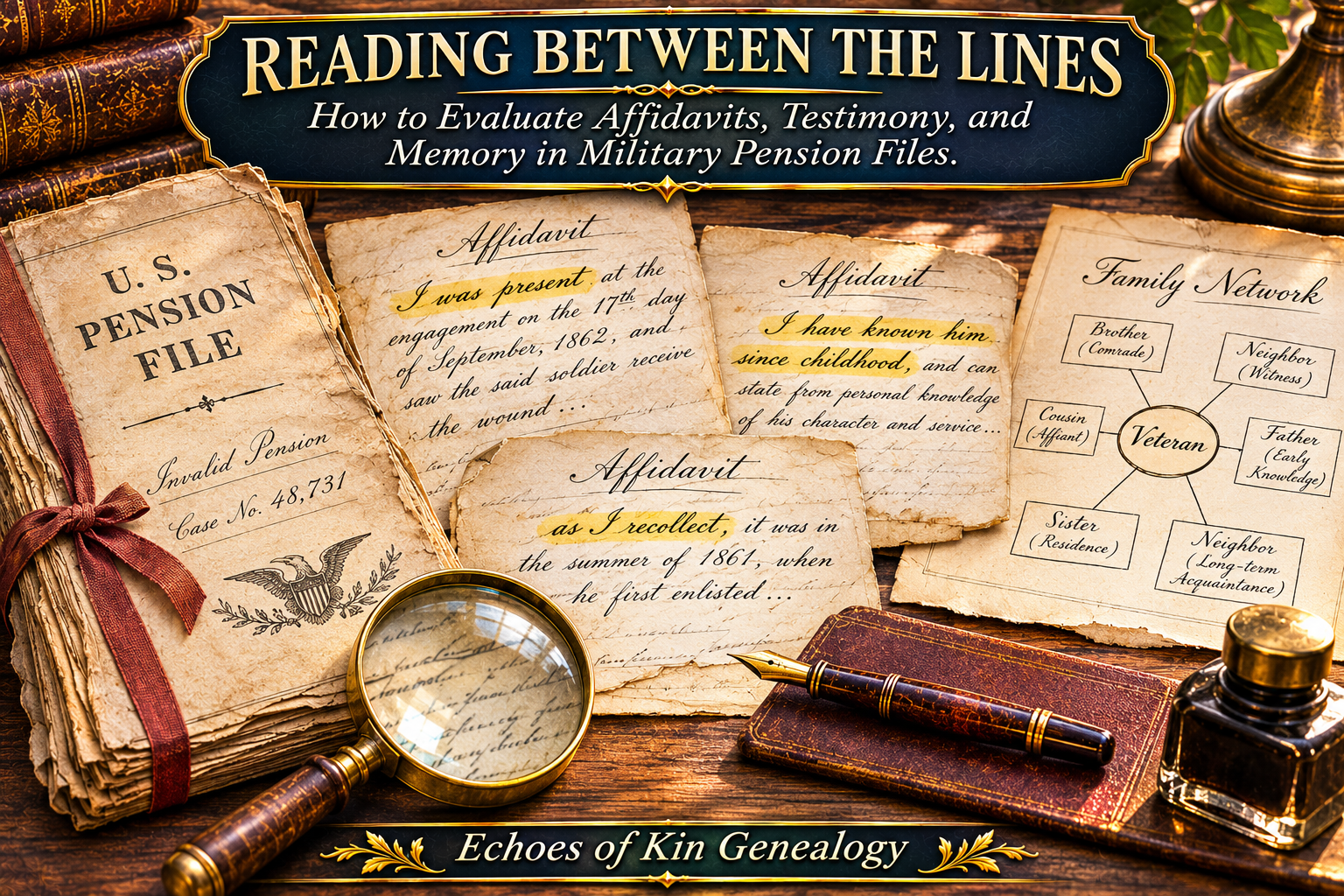
Posted on November 18, 2026 · By Echoes of Kin Genealogy
KEY TAKEAWAYS
- Evaluate every statement by its source, timing, and basis of knowledge. Affidavits contain extraordinary family-history evidence, but every claim must be weighed according to who spoke it, when they testified, and how they could have known the facts.
- Firsthand observation carries different weight than family tradition. “I attended their wedding” represents direct eyewitness testimony, whereas “I was always told they married before the war” reflects secondhand recollection or community knowledge.
- Treat the entire pension packet as a chronological conversation. Do not simply extract names and dates—relationships among witnesses, examiners’ questions, corrections, and conflicting statements reveal the broader community surrounding the applicant.
- Research the witnesses alongside your ancestors. Neighbors, comrades, and justices of the peace named in affidavits frequently turn out to be siblings, in-laws, or lifelong migration companions.
The Most Valuable Sentence in a Pension File
The most valuable sentence in a pension file may not come from the soldier at all. It may come from the neighbor who remembered a wedding, the sister who knew a maiden name, or the comrade trying to recall events fifty years after they happened.
There is something distinctly personal about discovering an ancestor’s family inside a military pension file. A census schedule gives us a static household, and a marriage register provides a single date, but opening a pension application introduces us to real people trying to explain their lives. A widow remembers when she married, an elderly veteran attempts to reconstruct the route his regiment marched decades earlier, a neighbor swears he knew the couple before the war, and a sister explains that the family Bible was lost in a house fire.
These records bring us remarkably close to the people we research, yet they are also deeply complex. Human memory shifts over time, witnesses misunderstand legal questions, dates drift, and applicants had a direct financial incentive for their claims to succeed.
None of those limitations makes pension testimony unreliable—quite the opposite. Federal pension application files are among the richest genealogical holdings at the National Archives, often preserving affidavits, marriage proofs, family Bible pages, correspondence, and service narratives. The skill lies in reading that testimony carefully without treating every sentence as equally authoritative.
Sometimes what a witness says is important; sometimes how they knew it is even more important.
Why Are There So Many Statements in Pension Files?
A military pension was a legal claim asking the government to provide financial benefits based on military service or a qualifying family relationship to a veteran. Because public funds were at stake, every claim required documentary proof. Depending on the specific pension act and the type of applicant, federal examiners demanded evidence of service, disability, marriage, widowhood, minor children’s ages, or parental dependency.
That administrative requirement is precisely where genealogy emerges between the government forms.
Imagine a widow named Margaret Lawson applying for a pension based on her late husband’s service, only to discover that her county marriage register burned in a courthouse fire. To prove her eligibility, Margaret had to assemble sworn testimony from the people around her: Who knew Margaret before her marriage? Who witnessed the wedding ceremony? Did neighbors recognize them as husband and wife? Had either spouse been married previously?
Suddenly, a federal bureaucratic process began recording detailed oral histories of a family—and 150 years later, genealogists get to listen in.
An Affidavit Is Evidence, Not Automatic Truth
The word affidavit carries an intimidating air of official authority—stamped, signed, and sworn before a magistrate. While those formalities confirm that a witness formally attested to a statement under oath, they do not guarantee that the witness’s memory was infallible.
Suppose an affidavit states: “I have known Sarah Mitchell for forty years and know her to be the widow of Jacob Mitchell.” That sentence provides a promising lead, but our immediate next step is to interrogate the witness’s basis of knowledge:
- Did she attend Sarah and Jacob’s wedding in person?
- Did she grow up beside them in the same neighborhood?
- Was she Sarah’s sister or sister-in-law?
- Or did she only meet Sarah after Jacob’s death and simply repeat what Sarah had told her?
An affidavit is evidence, not automatic truth. Before accepting any statement as fact, we must first understand the person speaking.

Begin With the Witness, Not the Statement
When encountering an important affidavit, resist the urge to immediately extract the dates and attach them to your family tree. Begin instead by researching the person who gave the testimony.
Suppose a seventy-eight-year-old woman named Rebecca Turner provides an affidavit in 1893 confirming the marriage of William and Martha Bell. Knowing who Rebecca was transforms how we weigh her words: if she was Martha’s older sister, she likely witnessed the wedding firsthand; if she was an unrelated neighbor who moved into the county twenty years after the ceremony, her knowledge was secondhand.
Research every witness just as you would an ancestor:
- Locate the witness in federal and state censuses across multiple decades.
- Determine where they lived relative to the applicant’s household.
- Trace their maiden name and marriage connections to check for hidden kinship.
- Verify whether their stated age and residence align chronologically with the event they describe.
A name that initially looks like a random neighbor frequently turns out to be the bride’s married sister or first cousin. Sometimes the witness belongs directly in your family tree.
“I Was There” Is Different From “I Was Told”
Distinguishing between direct eyewitness observation and secondhand family tradition is one of the most important habits in evidence evaluation.
| Statement Type | Example Wording in Affidavit | Evidentiary Classification | Genealogical Evaluation |
| Eyewitness/Firsthand | “I was personally present at the marriage of John Foster and Elizabeth Reed.” | Primary Information (for the event witnessed) | Witness claims direct observation; verify witness’s age and location at the time. |
| Hearsay/Tradition | “I have always understood that John and Elizabeth married about 1842.” | Secondary Information (community or family knowledge) | Longer path from event to statement; useful lead, but requires independent corroboration. |
Both witnesses may be entirely sincere, yet they provide fundamentally different kinds of evidence. A pension file routinely contains both eyewitness accounts and community hearsay side by side—never flatten them into identical facts inside your genealogy database.
Memory, Hedging Phrases, and the Passage of Time
Historical witnesses frequently signal the limits of their own memories, and careful researchers pay close attention to those cues. Phrases such as “to the best of my recollection,” “about the year,” “as near as I can remember,” or “I cannot state positively” tell us exactly where a witness felt confident and where details had faded.
Human memory is not a filing cabinet. An eighty-five-year-old Revolutionary War veteran giving a declaration in 1833 might recall his captain’s name, a brutal winter encampment, and a river crossing with crystal clarity while confusing whether a skirmish occurred in September or October. Similarly, a woman testifying in 1897 about a wedding she attended in 1851—forty-six years earlier—may vividly remember the ceremony while misremembering whether it took place on June 14 or June 17.
Revolutionary War pension files at the National Archives—comprising more than 83,000 case files and 2.3 million pages digitized in partnership with the National Park Service—span decades after the conflict ended. That long chronological gap is what makes the narratives so rich, and it is also why we must separate accurate core memories from drifting calendar dates rather than discarding an entire declaration over a single minor discrepancy.
Case Study: Correlating Differing Memories of a Wedding
- The Problem: Civil War veteran Samuel Price died in 1888, and his widow, Eliza, needed to prove their marriage without a surviving county certificate. Three affidavits were submitted:
- Eliza (Widow): States she and Samuel married in October 1859.
- Martha (Eliza’s Sister): Attests she attended the wedding “in the fall of 1859, shortly before harvest was finished.”
- Longtime Neighbor: States Samuel and Eliza were already living as husband and wife when he moved next door in 1860, though he did not attend the ceremony.
- The Correlation: Rather than contradicting one another, these statements converge. Martha supplies seasonal context, the neighbor confirms cohabitation by 1860, and when a church register later surfaces showing a marriage on 22 October 1859, all three memories align seamlessly.
Widow’s Pension Files: Rescuing Women From the Margins
For researchers tracing maternal lines, widow’s pension files are among the most rewarding records in American genealogy. Throughout the nineteenth century, married women frequently appeared in civil records solely under their husbands’ identities—Mrs. John Carter, widow of Thomas Bell, or mother of minor children.
To approve a widow’s claim, however, the Pension Bureau demanded specific biographical proof: her maiden surname, exact marriage date and location, whether either spouse had a prior marriage, and proof of the veteran’s death. Applications involving minor children added children’s full names, birth dates, and guardianships. Suddenly, a woman listed in a census simply as “Mary Johnson, age 42, born Ohio” gains a maiden name, a wedding date, a sibling’s sworn statement, and a family Bible record.
Read the Entire File in Chronological Sequence
A fifty- or hundred-page pension packet can tempt researchers into quick skimming, yet the single sentence that breaks through a brick wall may be tucked away on page eighty-four. A later affidavit might correct an earlier error, or a government examiner might uncover a previously unknown marriage.
Treat a pension file as a chronological sequence rather than a random stack of papers. Notice the order of the documents and ask what question the Pension Bureau was trying to answer at each stage:
- Examining Bureaucratic Questions: If a witness unexpectedly swears, “I know of no prior wife living at the time of their marriage,” look backward through the file—an earlier document likely hinted at a previous marriage or disputed identity.
- Spotting Chronological Gaps: If a widow submits an 1867 marriage certificate alongside birth proofs for children born in 1862 and 1864, keep reading for the follow-up affidavit explaining an earlier informal marriage or wartime delay.
💡 Michelle’s Pro-Tip: Hunt for the “Special Examiner’s Deposition”
“When reviewing a thick Civil War pension file, always check if the Pension Bureau referred the claim to a ‘Special Examiner’ in the field! When bureaucrats in Washington suspected fraud, a prior marriage, or conflicting identity claims, they dispatched a federal investigator straight to the veteran’s hometown to interview neighbors, former employers, physicians, and estranged relatives under oath. Those verbatim Q&A depositions—often tucked near the back of a 100-page file—read like unscripted nineteenth-century oral histories and routinely reveal family secrets, maiden names, and migration trails that no other record ever captured!”
Family Bibles Inside Pension Files Deserve Special Attention
Occasionally, an applicant tore the family-record pages directly out of a cherished family Bible and mailed them to Washington as proof of marriage or children’s births—where they remain preserved in the federal file today.
While discovering a Bible page inside a pension packet feels like striking genealogical gold, evaluate it as a physical artifact:
- Check the Publication Date: A Bible printed in 1870 cannot contain a truly contemporaneous entry written in 1822; it preserves a later family transcription of earlier events.
- Inspect Ink and Handwriting: Determine whether entries were recorded over decades in changing inks and hands, or written all at once in a single sitting.
- Verify Custody and Provenance: Note who possessed the Bible when it was submitted and whether the clerk certified it as an original tear-out or a transcribed copy.

FAN Club Networks, Clerks, and Signatures
Every name appearing in a pension file—neighbors, comrades, physicians, clergy, and justices of the peace—forms part of the applicant’s FAN Club (Friends, Associates, and Neighbors). A witness who testified that he knew the soldier “from boyhood” may turn out to be a lifelong migration companion who lived next door in Virginia in 1840 and moved alongside him to Missouri in 1858.
As you analyze witness statements, pay close attention to the mechanics of how the document was created:
| Document Feature | Analytical Pitfall | Methodological Best Practice |
| Clerk & Attorney Phrasing | Mistaking formal legalese for an illiterate farmer’s natural speech | Watch for moments where legal boilerplate breaks—nicknames, local landmarks, or personal details reveal the witness’s true voice. |
| Signatures vs. Marks (“X”) | Assuming a witness who signed with an “X” lacked accurate memory | Literacy and memory are separate; compare actual signatures against deeds and wills to distinguish same-name individuals. |
| Identical Phrasing Across Affidavits | Treating three nearly identical statements as three independent memories | Recognize when an attorney drafted a standard template for multiple witnesses to sign; weigh independence accordingly. |
| Historical Geography | Calling testimony “wrong” because a witness cited “old Virginia” for a West Virginia town | Evaluate place names using the county and state boundaries in effect at the time of the event (e.g., pre-1863 Virginia). |
Federal vs. Confederate Pension Systems
When searching for Civil War pension testimony, keep jurisdictional boundaries clearly in mind. Federal pension files held at the National Archives cover Union military service and qualifying dependents. Confederate pension systems were administered individually by former Confederate states (such as Virginia, North Carolina, Georgia, and Texas) rather than through the federal government.
If a Confederate ancestor does not appear in federal NARA pension indexes, that absence does not mean no pension existed—it simply directs your search to the state archives where the veteran or widow resided in old age.

The 10-Step Pension Affidavit Analysis Checklist
Before attaching any claim from a pension affidavit to your family tree, work through this 10-step evaluation roadmap:
- Order and Read the Complete Case File: Examine every page in chronological order, never stopping at an index card or cover sheet.
- Transcribe Key Testimony Verbatim: Type out critical affidavits word-for-word, preserving original spellings, corrections, and uncertain phrasing.
- Construct a Statement Timeline: Arrange depositions by the date each statement was sworn to trace how the claim evolved.
- Identify and Research Every Witness: Locate neighbors, comrades, and magistrates in censuses and deeds to uncover hidden kinship.
- Test the Witness’s Age Chronologically: Confirm the witness was old enough and geographically present to observe the event described.
- Classify Firsthand vs. Secondhand Knowledge: Separate direct eyewitness testimony from family tradition or community hearsay.
- Evaluate Examiner Questions and Bureaucratic Doubts: Look backward in the file whenever a witness answers an unusually specific question.
- Inspect Physical Artifacts and Bible Pages: Check publication dates, ink shifts, and signatures or marks on submitted family records.
- Correlate Claims With Independent Primary Records: Test pension statements against contemporary church registers, land deeds, and probate files.
- Preserve Both the Proof and the Human Voice: Record your analytical conclusion separately from the verbatim quote, keeping the witness’s lived story alive.

The Michelle Touch: A Personal Reflection
When we open a military pension file, we are stepping into a room where ordinary people—widows, aging comrades, sisters, and longtime neighbors—sat before a clerk and spoke their memories into the historical record.
Those memories are rarely tidy, and they are never infallible. Yet when we listen patiently, research the witnesses beside our ancestors, and test every claim against independent records, those fragile sworn statements become some of the richest human evidence we will ever inherit.
Warmly,
Michelle Bruner
Founder, Lead Genealogist · Echoes of Kin Genealogy
Continue the Conversation
Have you ever uncovered a hidden maiden name, an unexpected sibling, or a vivid wartime story tucked inside a military pension affidavit? Which witness in a pension file turned out to be a surprising relative or lifelong neighbor? Share your discoveries in the comments below.
At Echoes of Kin Genealogy, our professional research practice specializes in retrieving and analyzing federal and state military pension files, reconstructing FAN Club witness networks, resolving conflicting testimony, and building documented proof summaries under the Genealogical Proof Standard. Explore our research consulting services to discover how we can help trace your family’s story.
Leave a Reply