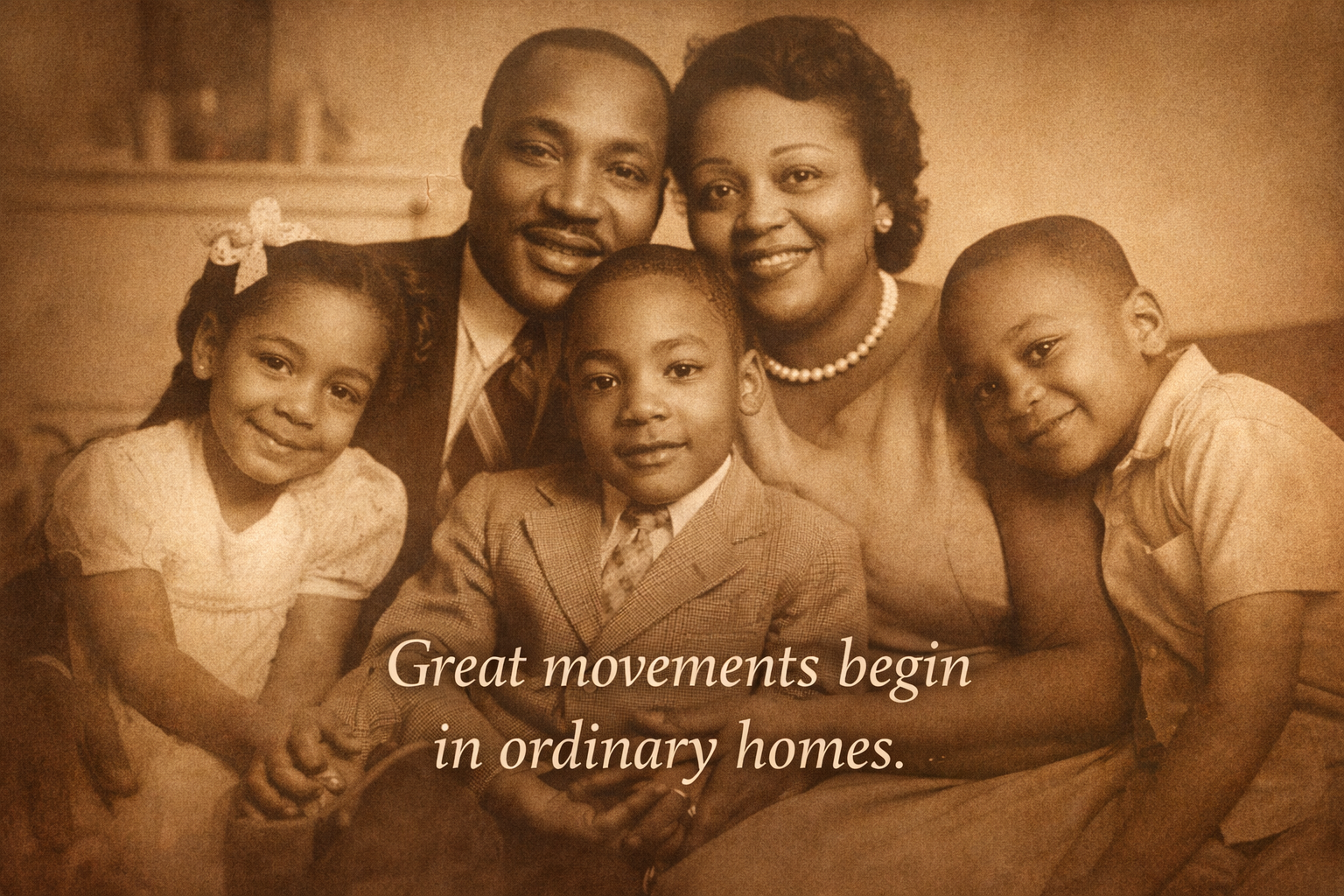
Each January, we pause to honor Dr. Martin Luther King Jr.—not simply because history tells us to, but because his life continues to echo through our families, communities, and collective memory.
At Echoes of Kin Genealogy, we believe remembrance is an act of care. It is how we honor those who came before us—not as distant figures frozen in textbooks, but as real people whose choices shaped the world we inherited. Dr. King’s story is one of those legacies that demands both remembrance and reflection.
A Life Rooted in Faith, Family, and Community
Dr. Martin Luther King Jr. was born on January 15, 1929, in Atlanta, Georgia, into a family where faith, education, and service were deeply intertwined. His father and grandfather were pastors, and from a young age, King learned that words carried power—and responsibility.
He grew up in the segregated South, where Jim Crow laws dictated where he could sit, learn, eat, and live. These injustices were not abstract ideas; they were daily realities. Yet within the walls of his home and church, King was taught dignity, purpose, and the belief that injustice was not inevitable.
Like so many ancestors we encounter in genealogical research, Dr. King’s early life was shaped by both limitation and hope—by a community that nurtured resilience even when the wider world denied it.
The Power of Nonviolence—and Moral Courage
Dr. King emerged as a national leader during the Montgomery Bus Boycott in 1955, following Rosa Parks’ arrest. At just 26 years old, he stepped into a role that would place his life—and his family’s safety—at constant risk.
What set Dr. King apart was not only his leadership, but his unwavering commitment to nonviolence. Inspired by his Christian faith and the teachings of Mahatma Gandhi, he believed that justice rooted in love had the power to transform society.
This belief was tested repeatedly—through arrests, threats, bombings, and relentless opposition. Yet Dr. King persisted, not because the path was easy, but because he believed future generations deserved better.
In genealogy, we often uncover ancestors who made quiet sacrifices for their children’s futures. Dr. King’s sacrifices were public, but the motivation was deeply familiar: to leave the world more just than he found it.
Why We Celebrate Martin Luther King Jr. Day
Martin Luther King Jr. Day is not a celebration of perfection—it is a recognition of purpose.
Established as a federal holiday in 1983 and first observed in 1986, the day exists to honor Dr. King’s legacy and the broader Civil Rights Movement. It serves as a reminder that progress was achieved through courage, community, and collective action—not inevitability.
Unlike many holidays, MLK Day is often called a “Day of Service.” That distinction matters. Dr. King believed that meaningful change came not just from words, but from action—ordinary people choosing to serve their neighbors and stand for justice.
Remembering the Man—Not Just the Monument
Over time, history can smooth the edges of real lives. Dr. King is often remembered for his “I Have a Dream” speech—but his story includes doubt, exhaustion, grief, and immense personal cost.
He was a husband, a father, a preacher, and a man who carried the weight of a movement on his shoulders. Remembering him fully means acknowledging both his vision and his humanity.
In family history work, we know that honoring ancestors means telling the whole story—not just the comfortable parts. Dr. King’s life reminds us that meaningful legacies are rarely easy, and lasting change often comes at great sacrifice.
Why His Story Still Matters Today
Dr. King’s work did not end with his assassination in 1968. The questions he raised—about justice, equity, dignity, and belonging—remain deeply relevant.
For genealogists, historians, and families alike, his legacy challenges us to ask:
- What values are we inheriting?
- What injustices remain unaddressed?
- What responsibilities do we carry forward?
History is not passive. It asks something of us.
A Final Reflection from Echoes of Kin Genealogy
Remembering Dr. Martin Luther King Jr. is more than honoring a national figure—it is an invitation to reflect on our shared humanity and the stories that shape who we are.
His life reminds us that:
- One voice can spark change
- Community sustains movements
- And remembrance is an act of responsibility
As we honor his day, may we also honor the countless unnamed individuals—ancestors, neighbors, everyday people—who worked toward justice in quiet and courageous ways.
Because history is not only what happened.
It is what we choose to remember—and how we carry it forward.
🌿 At Echoes of Kin Genealogy, we believe every story matters.
Leave a Reply