Posted on November 26, 2026 · By Echoes of Kin Genealogy
KEY TAKEAWAYS
- Family traditions are part of our genealogical heritage. Recipes, holiday customs, photographs, and shared stories reveal concrete connections between generations.
- Thanksgiving has a complex historical background. Understanding the holiday requires acknowledging its historical development and the experiences of both Indigenous peoples and European settlers.
- Family gatherings offer valuable research opportunities. Natural conversations with relatives can uncover memories and details that never appear in official civil records.
- Preserving today’s memories is also genealogy. The photographs, stories, and traditions we document this year become primary historical resources for future generations.
The Generations Behind Our Thanksgiving Table
Every family has its own version of Thanksgiving. For some, it is a gathering filled with familiar recipes, lively conversations, and the comfortable rhythm of traditions repeated year after year. For others, the holiday has evolved through marriage, migration, changing family circumstances, and the blending of different cultural backgrounds.
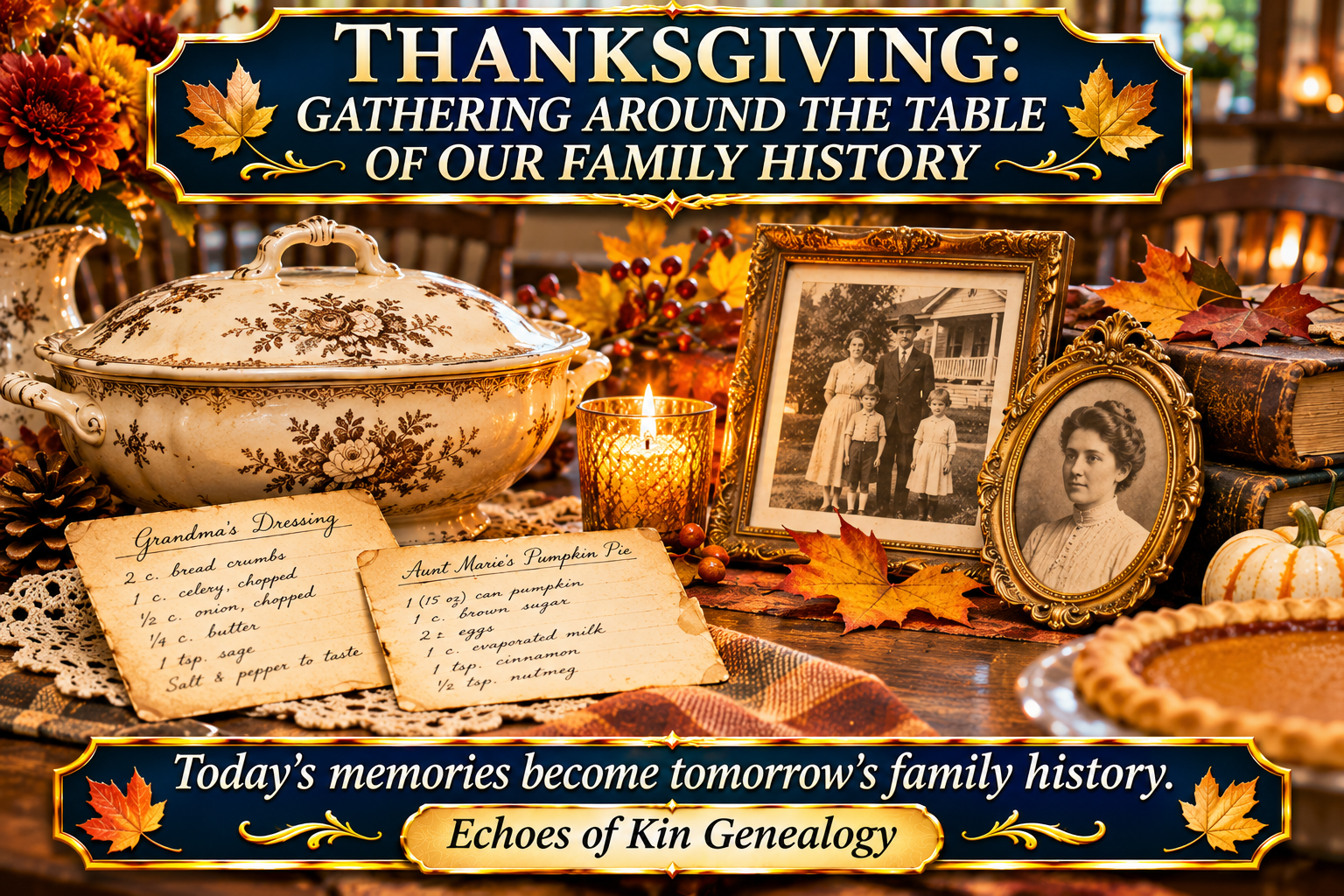
Perhaps there is a particular serving dish that appears on the table every November, a handwritten recipe passed between generations, or a story that someone inevitably tells while dinner is being prepared. These familiar details may seem ordinary, yet each carries the potential to reveal something about your family’s history.
Genealogy encourages us to look at these traditions differently. Instead of seeing Thanksgiving solely as an annual celebration, we can recognize it as an opportunity to explore the connections between the generations who established our family customs and those who continue them today. Who first prepared that favorite dish? When did the family begin gathering at a particular home? Did an immigrant ancestor introduce a recipe from another country, or did a tradition develop after the family settled in a new community?
The answers may not always survive in courthouse ledgers. Sometimes they live in the recollections of a grandparent, the handwriting on a stained recipe card, or the background of an old family photograph.
The Historical Roots of Thanksgiving
The history of Thanksgiving in the United States is far more complex than the simplified story many of us learned in childhood. Harvest celebrations, religious observances, and expressions of gratitude existed across numerous cultures long before the establishment of the American national holiday.
Indigenous communities maintained their own diverse traditions of gratitude, seasonal observance, and stewardship of the land, while European settlers brought religious and agricultural customs that included days of thanksgiving, prayer, and communal celebration.
The 1621 Gathering at Plymouth
The event commonly referred to as the First Thanksgiving took place in Plymouth in 1621, following the English settlers’ first successful harvest. The gathering involved English colonists and members of the Wampanoag people, including their leader Ousamequin, also known as Massasoit.
One of the principal surviving contemporary accounts comes from Edward Winslow and was published in Mourt’s Relation in 1622. His description provides evidence of a gathering that lasted three days, although it offers far fewer details than many modern illustrations and popular retellings suggest.
The 1621 harvest meal was not the beginning of an uninterrupted annual Thanksgiving tradition, nor does it fully represent the relationship between Indigenous peoples and European settlers. The decades that followed brought colonial expansion, displacement, warfare, and profound losses for Indigenous communities. For many Native Americans, Thanksgiving is also a day of mourning, reflection, and remembrance—and since 1970, the National Day of Mourning has been observed annually in Plymouth, Massachusetts.
For genealogists, the history of Thanksgiving illustrates an essential research principle: familiar historical narratives should always be examined alongside the surviving primary evidence and the perspectives of all communities involved.
How Thanksgiving Became a National Holiday
The Thanksgiving celebration familiar to many American families developed gradually over several centuries:
| Year | Historical Development |
| 1621 | English settlers and Wampanoag people participated in a three-day harvest gathering at Plymouth. |
| 1622 | Mourt’s Relation was published, preserving an early contemporary account of the gathering. |
| 1789 | President George Washington issued a national Thanksgiving proclamation, designating November 26 as a day of thanksgiving and prayer. |
| 1863 | Writer and editor Sarah Josepha Hale’s decades-long advocacy culminated in President Abraham Lincoln proclaiming a national Thanksgiving observance for the last Thursday in November during the Civil War. |
| 1939 | President Franklin D. Roosevelt moved the observance one week earlier to stimulate holiday commerce, sparking widespread debate among states. |
| 1941 | Federal legislation signed by Congress formally established Thanksgiving as the fourth Thursday in November. |
| Today | Thanksgiving continues to evolve through family traditions, regional foodways, and multicultural heritage. |
Understanding this timeline helps genealogists place ancestral Thanksgiving celebrations within their proper historical context. An ancestor living in eighteenth-century Virginia or New England would not have experienced the standardized fourth-Thursday national holiday familiar to twentieth-century families.

What Thanksgiving May Have Looked Like for Earlier Generations
Thanksgiving traditions have shifted alongside developments in transportation, food preservation, communication, and household technology:
- Thanksgiving in the 1800s: During the nineteenth century, religious services, family gatherings, and charitable meals became more widespread. Before modern refrigeration, agricultural households relied on drying, salting, smoking, pickling, and root-cellar storage, shaping menus around regional crops and local markets.
- Thanksgiving in the Early 1900s: Expanding railway networks and improved interurban transit allowed distant relatives to travel home for the holiday. Small-town newspaper social columns regularly announced married daughters returning home and siblings arriving from neighboring states.
- Thanksgiving During the Great Depression: Economic hardship in the 1930s affected households unevenly; newspapers published economical holiday menus and community relief announcements, while private letters reveal how individual families adapted.
- Thanksgiving During World War II: Military service, travel restrictions, and sugar, butter, and meat rationing reshaped holiday tables. Wartime letters written from overseas camps and newspaper furlough notices often preserve vivid snapshots of how families stayed connected across oceans.
Family Recipes: An Edible Record of Our Heritage
Among the most meaningful traditions associated with Thanksgiving are the recipes that return to the family table each year. Unlike birth certificates or census schedules, recipes were not created to prove kinship—yet they preserve tangible clues about cultural heritage, migration, and household exchange:
| Recipe Detail | Potential Family History Clue |
| Recipe written in another language | Possible linguistic or immigrant cultural heritage |
| Regional ingredients | Connections to local agricultural and culinary traditions |
| Handwritten ingredient substitutions | Changes in ingredient availability, rationing, or household tastes |
| Names written on recipe cards | Links to relatives, church friends, or former neighbors |
| Recipes in community cookbooks | Parish, grange, women’s club, or civic affiliations |
| Older measurements and instructions | Historical cooking methods (e.g., woodstove temperatures, teacups) |
| Notes in changing handwriting | Transmission across multiple generations |
| Newspaper recipe clippings | Identifiable historical publications and approximate dates |
A German-style potato dish, an Italian dessert, or a Scandinavian bread can inspire productive research into ancestral foodways—though a recipe alone cannot prove ethnicity, as dishes frequently traveled between neighbors and community cookbooks.

Preserve More Than the Ingredients
When documenting a family recipe, record who prepared it, where it originated, when it was traditionally served, and any memories attached to it. Photograph both the front and reverse of the original recipe card and transcribe the text alongside the image so the recipe remains legible even if the paper fades.
Thanksgiving Traditions and the Immigrant Experience
For immigrant families, Thanksgiving often became a bridge between an adopted American civic holiday and cherished cultural foodways. Over time, holiday tables blended classic autumn dishes with pierogi, tamales, lasagna, lumpia, or sauerkraut.
When tracing a dish’s origin, ask older relatives when they first remember it appearing at Thanksgiving and compare their recollections against immigration timelines. Sometimes a traditional dish originated with an immigrant grandparent; in other families, a second- or third-generation descendant reintroduced it to reconnect with their heritage. Both stories carry genuine historical value.
The Family Stories That Surface Around the Table
Holiday gatherings create relaxed moments that rarely occur during brief phone calls. A familiar photograph, an inherited platter, or a mention of a former family home can prompt relatives to share details absent from official records—such as the name of an immigrant boarding house, a childhood nickname, or the identity of an unlabeled face in an album.
15 Meaningful Questions to Ask This Thanksgiving
Rather than turning dinner into a formal interview, introduce these prompts naturally as conversation flows:
- What is your earliest memory of Thanksgiving?
- Where did the family usually gather when you were growing up?
- Who traditionally prepared the holiday meal?
- Which relatives traveled the farthest to attend?
- Were there family recipes that came from earlier generations?
- What do you remember about your grandparents’ home?
- Did the family celebrate differently when you were a child?
- Were there traditions connected to our family’s cultural heritage?
- Who in the family was known for telling stories?
- Do you remember relatives who lived in another state or country?
- Are there family photographs whose stories have never been recorded?
- What family traditions have disappeared over the years?
- Did military service, relocation, or historical events change how the family celebrated?
- What is something about our family that you hope future generations will remember?
- Is there a story about one of our ancestors that you have always wanted to share?

Family Stories Are Valuable Evidence, but They Still Need Verification
Oral histories preserve perspectives that never appear in civil registers, yet human memory evolves over time. Dates shift, stories merge across siblings, and details change in retelling. Treat every family story as a valuable research lead to be tested against independent historical records.
Genealogical Case Study: Tracking “Uncle Charlie” From Table Story to Proof
- The Family Tradition: Descendants recall hearing that an “Uncle Charlie” traveled from Montana to attend a Thanksgiving gathering in Illinois during the late 1930s, though no one remembers his surname or exact relationship.
- The Verification Strategy:
- Local Newspapers: Search Illinois society columns around November 1935–1939 for out-of-state holiday visitors.
- Federal Census & City Directories: Locate men named Charles living in Montana with birthplaces matching the Illinois family.
- Vital & Probate Records: Verify kinship through marriage certificates, obituaries, or estate distributions.
- The Payoff: If a 1937 society column reports “Charles Bennett of Billings, Montana, spent Thanksgiving with his sister, Mrs. Clara Miller,” oral tradition and contemporary evidence converge into documented proof.
Finding Thanksgiving in Historical Newspapers
Small-town newspapers from the nineteenth and early twentieth centuries routinely chronicled holiday travel, family dinners, and community celebrations in brief social items that preserve vital kinship clues:
Example Society Notice — The Daily Pantagraph (Bloomington, Illinois), November 28, 1895:
“Mrs. Clara Henderson and daughter, Miss Ethel, arrived from Peoria on Wednesday morning to spend Thanksgiving Day with her parents, Mr. and Mrs. Thomas Bennett, on North Main Street.”
In just two sentences, a single holiday social item links three generations, identifies a married daughter’s parents, confirms her current city of residence, and provides an exact street address.
| Newspaper Section | Potential Genealogical Discoveries |
| Local & Personal News | Out-of-town visitors, family reunions, and holiday travel |
| Society Columns | Full names of hosts, married daughters, and dinner guests |
| Church Announcements | Union Thanksgiving services and congregational gatherings |
| Military News | Service members home on furlough or stationed abroad |
| Advertisements & Menus | Historical food prices, local grocers, and regional menus |
Search issues published during the week before and after Thanksgiving—and remember that prior to 1941, state governors occasionally proclaimed different November Thursdays. Combine surnames with search terms such as “Thanksgiving dinner,” “Thanksgiving guests,” “home for Thanksgiving,” and “holiday visitors” across Chronicling America, Newspapers.com, GenealogyBank, and local library microfilm collections.
Family Photographs: Preserving the Faces Around the Table
Thanksgiving photographs capture more than smiling faces—they preserve former family homes, parlor furniture, heirloom serving dishes, and everyday life. Yet photographs rapidly lose their meaning when separated from the names and dates behind them.
| Information to Record | Example Entry |
| Occasion & Date | Thanksgiving Dinner — November 26, 2026 |
| Location | Residence of Thomas & Clara Miller, Fort Wayne, Indiana |
| People Pictured | Full names listed clearly from left to right |
| Relationships | Relationship to the host or anchor ancestor |
| Heirlooms Shown | Grandmother’s silver gravy boat and embroidered tablecloth |
| Informant / Source | Identified by Aunt Margaret Miller on November 26, 2026 |
💡 Michelle’s Pro-Tip: The “Smartphone Audio + Photo” Trick at the Dinner Table
“When you pass around an unlabeled family photograph at Thanksgiving and an older relative suddenly lights up and says, ‘Oh, that’s Aunt Clara’s wedding in 1948—she’s standing right next to Uncle Frank before he moved to Oregon,’ do not scramble for a pen and paper! Open your smartphone’s Voice Memos app, hold the phone near the photograph, and record their exact words while snapping a quick photo of the picture with your phone. You preserve both the image and the exact voice, tone, and unedited memory of the relative who identified it—with zero risk of mishearing a name or date.”
Remembering Those Who Are No Longer at the Table
Thanksgiving naturally brings an awareness of the relatives whose presence once shaped the holiday. For some families, preparing a grandmother’s recipe or displaying an inherited photograph brings deep comfort; for others, the season carries recent grief or complicated family dynamics.
Remembrance does not require an elaborate ceremony. Preserving a relative’s name on the back of a photograph, transcribing a handwritten letter, or recording the origin of a favorite recipe ensures their place in the family story endures quietly and respectfully.
Six Ways to Weave Family History Into Thanksgiving
- Create an Ancestor Remembrance Table: Display framed copies of ancestral portraits, family heirlooms, or handwritten recipes alongside small tent cards noting each person’s name, dates, and relationship.
- Prepare an Ancestral Recipe: Serve a dish from an earlier generation and share its documented backstory—or invite relatives to help trace its origins.
- Display a Family Migration Map: Pin the towns, counties, and countries where earlier generations lived to spark conversations about how different branches converged.
- Identify Old Family Photographs: Set out a small stack of unlabeled snapshots and record relatives’ identifications (and any uncertainties) as they look through them.
- Start a Thanksgiving Memory Journal: Pass around a bound notebook each year for family members to jot down a favorite memory, milestone, or reflection.
- Take an Annual Group Portrait: Capture a dated group photograph every Thanksgiving and log everyone pictured from left to right before the weekend ends.
Thanksgiving Across the Generations: A Family History Project
One rewarding long-term project is reconstructing how your family observed Thanksgiving across five generations—working backward from today’s table through interviews, slides, postcards, and nineteenth-century newspapers:
| Generation | Timeframe | Documented Thanksgiving Evidence |
| Generation 1 (Current) | 2026 | Labeled digital portraits, recorded table stories, and updated recipe journal |
| Generation 2 (Parents) | 1980s | Handwritten recipe cards, Polaroid snapshots, and family camcorder footage |
| Generation 3 (Grandparents) | 1950s | Labeled Kodachrome slides of extended family gathered on the front porch |
| Generation 4 (Great-Grandparents) | 1918 | Handwritten postcard describing a wartime Thanksgiving dinner under sugar rationing |
| Generation 5 (Great-Great-Grandparents) | 1885 | Local newspaper social item noting out-of-town children visiting for dinner |
Where documentation is incomplete, note the gaps honestly rather than inventing traditions. A timeline accurately documenting three generations is far more valuable than one that guesses at five.

Gratitude for the Records That Survived—And the Ancestors We Will Become
Genealogists develop a deep appreciation for the quiet decisions that allowed historical evidence to survive: a grandmother who saved a bundle of letters, a county clerk who maintained a legible register, a photographer who labeled an album, and an archivist who preserved fragile paper long after its original purpose ended.
Yet as we look backward at the records left behind for us, it is worth remembering that we are someone’s future ancestors. Future descendants may wonder where we gathered for Thanksgiving, what recipes filled our table, and what mattered most to our families. A snapshot taken while dinner is being prepared, a recipe preserved in your handwriting, or a five-minute voice recording of a grandparent’s laugh may one day become the centerpiece of a descendant’s family archive.

The Michelle Touch: A Thanksgiving Reflection
However your family gathers this Thanksgiving, the holiday offers a meaningful pause to reflect on the lives, migrations, and quiet resilience that brought us to the present table. Our ancestors’ histories are rarely simple—some chapters carry joy and abundance, while others reflect hardship, loss, or unanswered questions that require patient research to untangle.
When we take a few quiet minutes to ask about a recipe’s origin, write names on the back of a photograph, or listen closely to an older relative’s memory, we honor the past without romanticizing it—and ensure that the stories entrusted to our generation endure for those still to come.
Wishing you and yours a warm, meaningful, and memorable Thanksgiving.
Warmly,
Michelle Bruner
Founder, Lead Genealogist · Echoes of Kin Genealogy
Continue the Conversation
What Thanksgiving tradition or recipe has been passed down through your family? Have you ever uncovered a surprising ancestor or family story in a holiday newspaper column or unlabeled photograph? Share your traditions in the comments below.
At Echoes of Kin Genealogy, we help families uncover documented ancestral stories, verify family traditions under the Genealogical Proof Standard, and preserve meaningful connections across generations. Subscribe below to The Chromosome Chronicles for practical genealogy research guidance, historical context, and reflections on preserving your family’s legacy.
Leave a Reply