Posted on November 11, 2026 · By Echoes of Kin Genealogy
KEY TAKEAWAYS
- Uniforms are standardized artifacts. Military clothing was governed by strict branch and era regulations. Collar devices, rank chevrons, shoulder patches, headgear, and coat tailoring provide vital clues to narrow a photograph’s timeframe.
- A uniform dates an era, not an identity. Establishing that a tunic was issued during World War I does not prove which family member was wearing it; visual clues must be correlated with documentary paper trails.
- Look beyond the portrait face. Studio imprints, city stamps on cardboard mounts, and handwritten inscriptions on the reverse side frequently solve the mystery faster than the uniform itself.
- Archival gaps can be bridged. The catastrophic 1973 National Personnel Records Center fire destroyed millions of Army files, but county-level discharge registrations, draft cards, and local newspapers help reconstruct service histories.
Somewhere in your family collection—perhaps tucked behind a formal wedding portrait in an inherited frame or slipped between the pages of an old scrapbook—there is a photograph of someone in a military uniform.
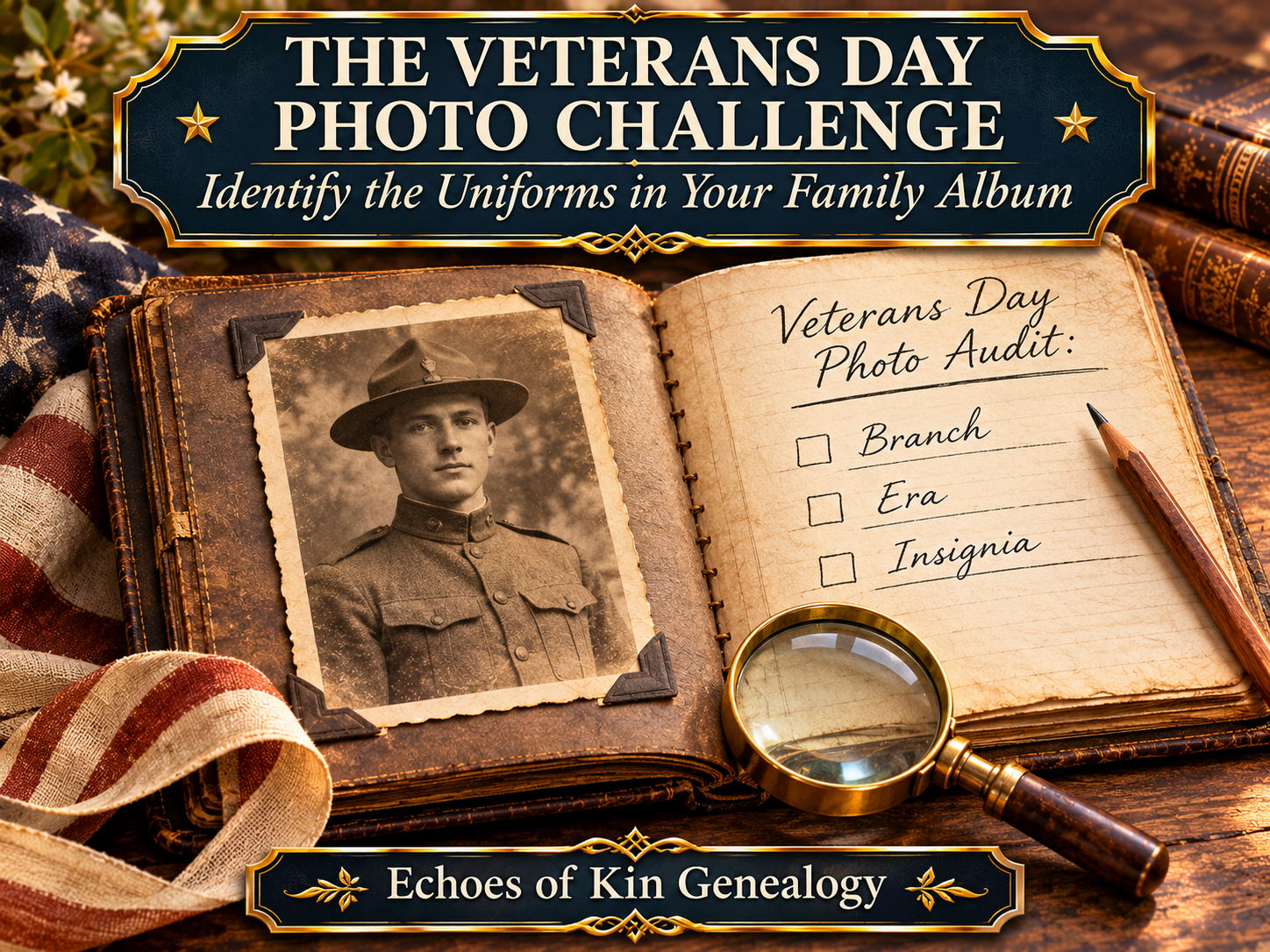
The portrait may be mounted on heavy cardstock with softened corners, showing a young service member looking directly into the lens. A service cap sits cocked at an angle, and an embossed brass button or small collar disk catches the light. On the reverse, someone penciled a first name decades ago, but left off the surname. Or perhaps the back is entirely blank.
You have likely looked at this portrait before, wondering whether the person pictured was a grandfather, an uncle, or a distant cousin whose name has faded from family conversations.
The uniform confirms military service, but which branch? Which conflict? What specific historical story is waiting inside that frame?
This Veterans Day, take another look at that portrait with a researcher’s eye. November 11 is an opportunity to honor those who served in the United States Armed Forces, and for family historians, it offers a meaningful moment to preserve the documented truth of that service.
Sometimes that work begins with a single photograph.
Why Military Photographs Matter in Genealogy
Military portraits frequently survive when other family papers have been lost. A soldier may have carried a studio print in his pocket throughout training, mailed a postcard portrait home to parents before shipping overseas, or exchanged small prints with siblings. Over time, those images found their way into family collections, even as the specific details of service were forgotten.
What makes military portraits uniquely valuable to researchers is that uniforms were strictly regulated. Military branches established detailed specifications for cut, fabric, rank, occupational insignia, and accoutrements. Those regulations evolved across conflicts.
As a result, a uniform provides physical evidence that can date a photograph to a narrow window of years. The design can also indicate branch of service, unit assignment, rank, and specialized training.
However, an essential distinction must guide your research: identifying a uniform is not the same as identifying the person wearing it.
A uniform may prove that a photograph dates to 1918 without proving that the young man pictured is your grandfather. A wartime portrait taken in a domestic training camp does not automatically mean combat deployment or overseas service.
To bridge that gap, visual evidence must always be paired with documentary records.
The Veterans Day Photo Challenge: Seven Steps to Investigate a Military Portrait
Choose one unidentified military photograph from your collection. You do not need to solve the entire mystery in an afternoon; the goal is simply to observe the details, record the clues, and build a targeted research plan.
Step 1: Examine the Physical Artifact
Before launching an online database search, spend ten minutes examining the physical object in good, indirect light. If the photograph is loose, handle it carefully by the edges.
💡 Michelle’s Pro-Tip: The “Cardboard Sandwich” Warning
“If you discover an unidentified military portrait glued down inside an old black-paper magnetic album, stop! Never attempt to peel, scrape, or pull the photograph away from brittle backing paper or vintage adhesive. You risk tearing the paper layer holding the image emulsion or ripping away faint pencil inscriptions on the reverse. Instead, place a clean sheet of acid-free paper over the face, take a glare-free high-resolution digital photograph in indirect daylight, and consult an archivist or photo conservator before attempting physical removal.”
Examine the entire artifact from edge to edge:
- Handwritten names, initials, dates, or military base references
- Photographer names, studio logos, and street addresses embossed on cardboard mounts
- Uniform insignia, rank chevrons, shoulder sleeve patches, and campaign ribbons
- Studio props, painted backdrops, or outdoor barracks that suggest a specific military facility
- Additional individuals pictured in the frame
Pay close attention to the reverse side. A brief penciled note such as “Frank, Camp Grant, 1918” provides a much stronger research foundation than the uniform cut alone.
Even an unfamiliar photographer’s mark can unlock the case. Studio directories, city business directories, and local newspaper advertisements can establish the precise years a photographer operated at that street address.
Research tip: Scan both the front and reverse sides at a minimum of 600 DPI. Save an uncompressed master archival file (TIFF) before cropping or adjusting contrast for closer inspection.
Step 2: Identify the General Military Era
Begin with the overall silhouette and construction of the uniform.
Does the jacket feature a high standing collar, an open lapel worn with a necktie, or a traditional sailor jumper? Is the headgear a peaked visor cap, a wide-brimmed campaign hat, or a foldable garrison cap?
While military branches sometimes retained older uniform patterns during supply shortages, general tailoring shifts provide a strong baseline:
| Historical Era | Prominent Uniform Features to Investigate |
| Civil War (1861–1865) | Wool frock coats, shorter sack coats, forage caps, kepis, branch-colored piping, and brass buckle plates. |
| Spanish-American War (1898) | Tan khaki and blue wool field uniforms, broad-brimmed felt campaign hats, and late-19th-century service tunics. |
| World War I (1917–1918 U.S.) | Olive drab wool service coats with stiff, high standing collars; circular brass collar disks; overseas caps; and felt campaign hats. |
| World War II (1941–1945 U.S.) | Open-collar service coats with lapels and ties; foldable garrison caps; distinctive shoulder sleeve insignia (division patches); and branch dress variations. |
| Korean War Era (1950–1953) | Transitional mid-century service uniforms, wool field shirts, olive drab fatigue sets, and modernized rank chevrons. |
| Vietnam War Era (1955–1975) | Tropical utility fatigues (jungle dress), embroidered olive and black name tapes, subdued insignia, and berets or utility caps. |
These descriptions are broad indicators rather than absolute rules. Always cross-check an estimated uniform date against your family tree; if an inherited portrait is presumed to show an ancestor who passed away in 1912, an open-lapel World War II uniform immediately disproves that identification.

Step 3: Study the Insignia Under Magnification
The smallest metallic emblem or embroidered patch often provides the decisive clue in military photo analysis. Insignia can appear on collar points, shoulder epaulets, upper sleeves, breast pockets, and headgear.
Under magnification, focus on these details:
- Rank Insignia: Pointed chevrons, officer bars, oak leaves, eagles, or naval rating badges indicate rank within a specific branch and era.
- Branch Devices: Crossed rifles (Infantry), crossed cannons (Field Artillery), winged propellers (Army Air Forces), or fouled anchors (Navy) reveal service branch or specialty.
- Unit Patches: Distinctive shoulder sleeve insignia (SSI) worn on the upper left arm identify specific divisions, corps, or armies.
- Service Ribbons & Medals: Ribbon bars mounted above the left breast pocket reflect specific campaigns or decorations, helping establish whether a portrait was taken during service or following demobilization.
- Buttons and Cap Badges: Federal eagle buttons, state militia seals, or naval anchor devices are often readable even when fabric details are dark or faded.
Remember that rank conventions changed over time. An Army corporal chevron from 1918 should not be evaluated using modern military charts without consulting period-specific uniform regulations.

Step 4: Look Beyond the Uniform
A photograph often preserves valuable context that has nothing to do with military tailoring.
Is the service member seated beside a spouse or child? Was the portrait taken on a postcard mount meant to be mailed from a mobilization camp? Does the picture sit in an album alongside known maternal cousins?
The photographer’s studio city may reveal where a soldier was stationed during initial training, rather than where he lived as a civilian. While album placement is supporting context rather than absolute proof—albums were frequently rearranged or passed down across branches—these environmental associations help narrow the scope of your search.

Step 5: Build a Candidate Roster from Your Family Tree
Once you establish an approximate timeframe and service branch, turn to your pedigree charts. Which family members were the appropriate age to serve during that conflict?
Consider an unidentified World War I portrait showing an Army private in a high-collared tunic. Reviewing your family tree reveals two brothers:
- Arthur Miller, born in 1893 (age 24 in 1917)
- Charles Miller, born in 1901 (age 16 in 1917)
Arthur is immediately a strong candidate based on typical enlistment ages. However, Charles should not be completely ruled out without checking records; underage enlistment occurred throughout American military history.
Locating a 1917 draft registration card for Arthur and finding his name in local military mobilization lists strengthens the case for him. Still, finding a service record for Arthur does not prove the portrait depicts him; you must continue searching for corroborating physical descriptions, letters, or labeled comparison photos.
Step 6: Correlate the Image with Documentary Records
Once you have identified a likely candidate, test your working hypothesis against documentary evidence:
- Draft Registration Cards: World War I and World War II draft records document birth dates, occupations, next of kin, and valuable physical descriptions (height, build, eye color, and hair color). Note that registering for the draft does not prove military service occurred.
- County Discharge Registers: When veterans returned home from World War I and World War II, county clerks frequently recorded their official separation papers (Form DD-214 or WD AGO 53-55) in local deed or courthouse registers to preserve their benefits. These local recordings often survive even when federal files are lost.
- Muster Rolls and Rosters: Regimental returns and branch muster lists place an individual in a specific company or vessel on specific dates.
- Hometown Newspapers: Local presses regularly published columns featuring letters from the front, promotions, wounded lists, and welcome-home announcements.
- Veterans’ Headstone Applications: Federal applications for military markers document rank, company, regiment, enlistment dates, and discharge dates.
Keep in mind that on July 12, 1973, a disastrous fire at the National Personnel Records Center (NPRC) in St. Louis destroyed approximately 80% of U.S. Army personnel files for service members discharged between 1912 and 1960. A missing federal personnel file does not mean your ancestor never served; it simply means you must rely on local courthouse filings, state adjutant general rosters, and draft records to reconstruct their military history.

Step 7: Document What You Know—and What Remains Uncertain
The final step is one that family historians often skip: documenting your findings even when the case remains open.
Create a formal research note recording the photograph’s provenance, the current custodian, uniform details, estimated dates, and every record searched. Organize your conclusions into three clear categories:
- Established: Facts verified by the photograph or primary records (e.g., “Subject wears a U.S. Army M1917 service coat with Infantry collar insignia”).
- Hypothesized: Interpretations supported by evidence but not yet confirmed (e.g., “Candidate is likely Arthur Miller, based on 1917 draft registration in Rockford, Illinois”).
- Unresolved: Questions requiring additional proof (e.g., “Military serial number not yet confirmed; county discharge ledger search pending”).
Documenting what remains unproved prevents working hypotheses from turning into unverified family lore.

What If the Uniform Belongs to a Woman?
Military portraits in family collections are not limited to men. American women served in vital military and military-associated roles throughout the twentieth century.
They served as nurses in the Army and Navy Nurse Corps, as Navy WAVES (Women Accepted for Volunteer Emergency Service), in the Women’s Army Corps (WAC), as Coast Guard SPARS, and in civilian volunteer organizations such as the American Red Cross and the United Service Organizations (USO).
Uniform tailoring and insignia differed significantly between official military branches and volunteer auxiliaries. Identifying the specific organization and its legal status is critical for locating service documentation.
Do not assume a woman in uniform was simply posing in a relative’s jacket or serving only in an informal role; research her insignia with the same rigor you would apply to any other military portrait.
The Veterans Day Invitation: Choose One Photograph
This Veterans Day, take an hour to open your family album and choose one military portrait that has remained unidentified.
Scan the image at high resolution, examine the collar devices, read the studio imprint, and compare the estimated date against your tree. If the identity remains unconfirmed, write down what you observed; that research note may provide the breakthrough clue for another relative years from now.
If you succeed in identifying the service member, write a comprehensive caption for your digital files that includes their full name, unit, and the documentary sources that prove the connection.
Behind every uniform was a real person facing an uncertain chapter of history. When we take the time to study their insignia, locate their records, and record their verified names, we ensure their service is remembered truthfully for generations to come.
Warmly,
Michelle Bruner
Founder, Lead Genealogist · Echoes of Kin Genealogy
Continue the Conversation
Do you have an unidentified military photograph in your family collection? What collar device, studio location, or handwritten note are you trying to decipher? Share your mystery in the comments below.
At Echoes of Kin Genealogy, our professional research practice specializes in analyzing historical photographs, untangling military paper trails, and connecting family heirlooms to verified archival evidence. Explore our research services to discover how we can help you recover your family’s military history.
Leave a Reply