Posted on June 24, 2026 · By Echoes of Kin Genealogy
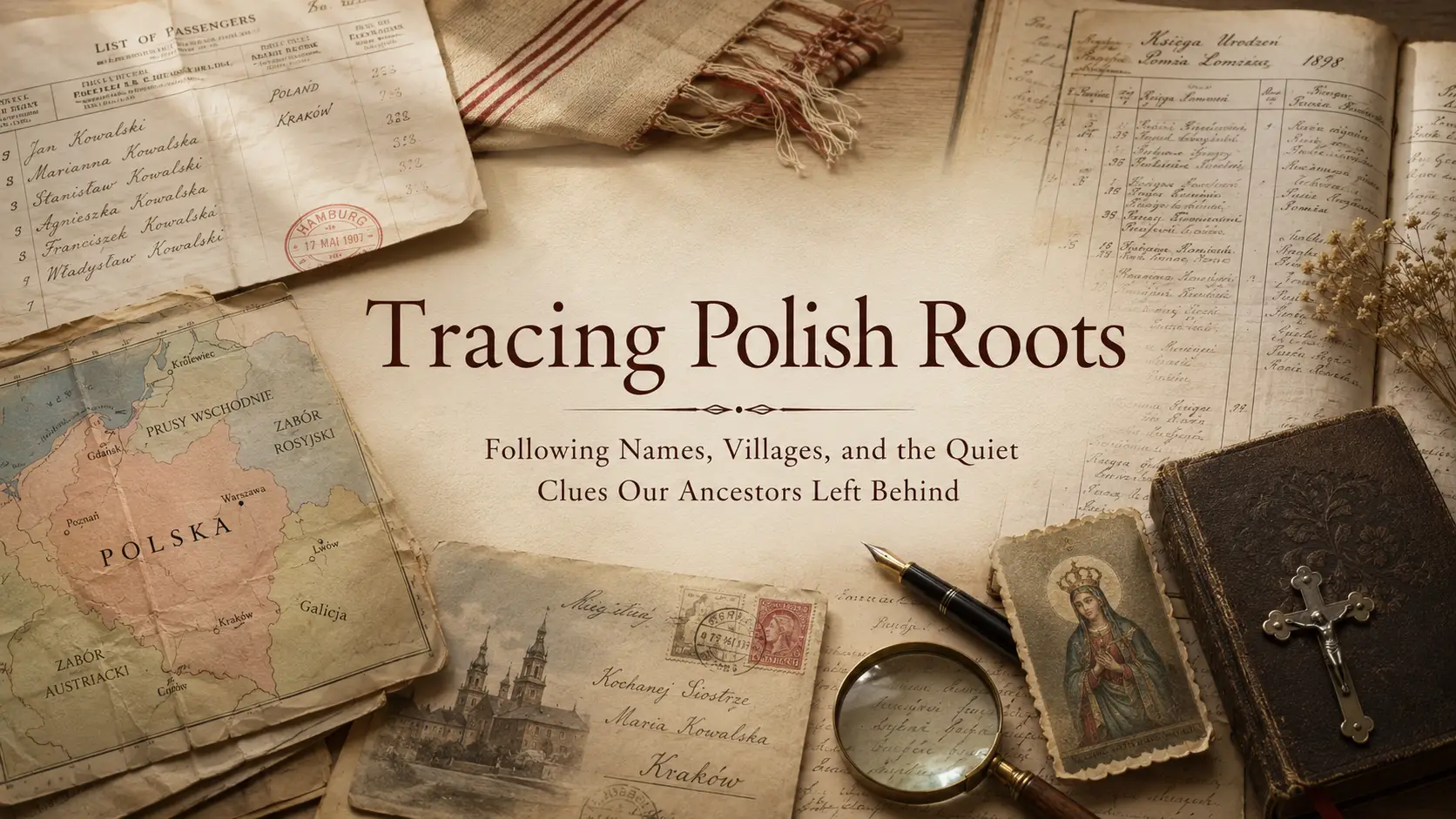
Sometimes Polish family history begins with a name that has been softened by time.
A surname spelled three different ways. A village remembered only as “near Kraków.” A grandmother who said she was Polish, though the ship record lists Austria, Russia, Prussia, Galicia, or simply “Europe.” These small confusions can feel discouraging at first, but they are often part of the story itself. Polish roots are rarely traced in a straight line. They ask us to listen carefully, compare gently, and remember that borders moved while families kept living, marrying, praying, farming, leaving, and beginning again.
Tracing Polish ancestry is not just about finding a record. It is about restoring context. A baptism entry may tell us a child’s name, but it can also place that child in a parish, beside godparents, in a language shaped by empire, faith, and local custom. A marriage record may quietly reveal a mother’s maiden name, a father’s occupation, or the village where a family had lived long before anyone imagined crossing an ocean.
That is where the work becomes personal.
Why Polish Genealogy Can Feel Complicated

Polish research can be deeply rewarding, but it often asks for patience. For many families, the difficulty is not that records do not exist. It is that the records may be scattered across languages, archives, religions, and political histories.
For much of the 1800s and early 1900s, Poland was partitioned among neighboring powers. Depending on the place and time, records might appear in Polish, Latin, Russian, German, or sometimes a mixture of local phrasing and official format. A person who thought of herself as Polish might have been recorded by an American clerk as Austrian, Russian, or German because that was the empire controlling her birthplace at the time.
That does not make the family story wrong. It means the record needs translation, geographically and historically.

Start at Home Before You Search in Poland
Before opening an archive website, begin with what is closest.
Look for:
- Naturalization papers
- Passenger lists
- Obituaries
- Funeral cards
- Church sacramental records in the United States
- Marriage licenses
- Old letters, postcards, prayer books, and photograph backs
- Draft registrations
- Social Security applications
- Cemetery records
The Polish State Archives recommends beginning with home sources and family documents before moving outward into formal archival research. That may sound simple, but it is often where the most important clue appears: the village name.
A family might say “Warsaw,” but the record may later show a small village forty miles away. That does not necessarily mean anyone lied. Large cities often became shorthand, especially when relatives were explaining an unfamiliar place to American-born children.
A realistic example
Imagine finding a 1912 passenger list for a man named Jan Kowalski. The surname appears as “Kovalsky,” his nationality is listed as Russian, and his last residence looks like “Lomza.” At first glance, you may wonder whether this is even the right person.
But then his U.S. marriage record names his parents as Piotr Kowalski and Marianna Zielińska. His obituary says he was born near Łomża. A child’s baptism record at a Polish parish in Chicago names a godparent with the same Zieliński surname. Suddenly, the pieces begin to lean toward one another. Not proof by themselves, but enough to build a careful research path.
The Village Matters More Than the Surname
In Polish genealogy, the village or parish is often the key that opens the door.
Surnames can be common. Kowalski, Nowak, Wiśniewski, Wójcik, Zieliński, Kamiński, and many others appear across Poland. Searching only by surname may produce hundreds of possibilities. Searching by surname plus parish, nearby villages, approximate dates, and family relationships becomes much stronger.
When you identify a likely village, ask:
- What parish served that village?
- Was it Roman Catholic, Greek Catholic, Jewish, Lutheran, Orthodox, or another community?
- Which archive holds the older records?
- Are the records indexed, digitized, or only described in an archive catalog?
- Did the village belong to a different administrative region during your ancestor’s lifetime?
This is where Polish research becomes less like typing a name into a box and more like learning the landscape your ancestor knew.
Key Online Tools for Polish Roots
Several major resources can help researchers move from family clues into Polish records.
Geneteka
Geneteka is a major Polish genealogy database hosted by the Polish Genealogical Society. FamilySearch describes it as one of the largest databases for Polish genealogy, containing millions of indexed birth, marriage, and death records.
Geneteka is especially helpful because it allows surname searches across regions, though not every parish is indexed and coverage varies. A result in Geneteka should usually be treated as a pointer toward the original record, not as the final answer.
Use it to look for:
- Births and baptisms
- Marriages
- Deaths and burials
- Maiden names
- Parent names
- Clusters of related families in the same parish

Szukaj w Archiwach, Search the Archives
The Polish State Archives’ Szukaj w Archiwach, or Search the Archives, provides online access to archival descriptions and many digitized scans. The service includes parish and civil records, maps, photographs, and other archival materials.
The National Digital Archives notes that Szukaj w Archiwach presents scans and descriptions of materials collected in Polish archives, with more than 55 million scans available through the service.
This matters because not everything is indexed by name. Sometimes the record is online, but you must browse the book page by page. That can feel slow. It can also be strangely moving. You begin to see your ancestor’s family among neighbors, repeated surnames, witnesses, godparents, and handwriting that belonged to a clerk who never imagined us reading it generations later.
PRADZIAD and Archive Guides
The Search the Archives site also points researchers toward PRADZIAD, a database used to identify parish and civil registration records. The site explains that genealogical materials often include vital records such as births, marriages, and deaths, along with other sources like address registration books and ID files.
PRADZIAD is useful when you need to know whether records exist for a place and where they may be held.
FamilySearch Wiki
The FamilySearch Poland research pages are a helpful starting point, especially for beginners who need orientation by region, record type, or archive. Its Poland getting started guidance emphasizes gathering a name, approximate dates, religion, relatives, and especially a place of origin before searching Polish records.
Do Not Rush Past the Original Record
Indexes are wonderful. They save hours, sometimes days. Still, the original record often holds the better story.

A marriage index may show:
Stanisław Majewski married Katarzyna Baran, 1898
The original record might add:
- Ages of bride and groom
- Birthplaces
- Parents’ names, including mothers’ maiden names
- Whether parents were living or deceased
- Witnesses
- Occupation
- House number
- Religious parish
- Prior marriage status
One small note can change the next step. A house number may distinguish two men with the same name. A witness may later turn out to be a brother-in-law. A mother’s maiden name may carry the line into an entirely new parish.
Why This Matters in Family History
Polish genealogy is not only about “getting back another generation.”
It can help explain why a family left, why they settled near certain neighbors, why they joined a particular church, why a surname changed, or why a grandmother kept a framed holy card tucked inside a drawer. It may reveal that the family did not migrate alone, but as part of a chain of cousins, godparents, neighbors, and future in-laws.
For descendants, this can soften old mysteries.
A family story that once sounded vague, “They came from near the Russian border,” may become more human when you see the village on a map. You notice the river nearby. You find the parish church. You realize the border was not just a line in a history book. It was part of how your ancestor was counted, taxed, conscripted, recorded, and sometimes misunderstood after immigration.
Records do not replace memory. They give memory a place to stand.

Common Polish Research Challenges
Name spellings shift
A Polish name may look different in American, German, Russian, or Latin-language records. For example, Wojciech may appear as Adalbert in Latin church records. Stanisław may become Stanley in the United States. Surnames may lose diacritical marks, such as Ł, ń, ś, or ż, when written by English-speaking clerks.
Borders changed
A birthplace listed as Austria on a U.S. record may point to Galicia, a region with many Polish and Ukrainian communities under Austrian rule. A record saying Russia may refer to the Russian partition of Poland, not necessarily modern Russia.
Religion shapes the record trail
Roman Catholic parish books are common for many Polish families, but not all Polish ancestors were Roman Catholic. Jewish, Lutheran, Greek Catholic, Orthodox, and other communities had their own recordkeeping patterns. The right religious context can prevent a long and frustrating search in the wrong place.
Not every record is indexed
This is worth repeating kindly. No result does not mean no record. It may mean the parish has not been indexed, the surname was spelled differently, the scan is online but unindexed, or the record remains in an archive, registry office, diocesan archive, or local parish.
A Gentle Research Plan for Tracing Polish Roots
1. Write down what your family already knows
Do not correct the story too quickly. Preserve it first. Write down the exact words relatives used, even when they seem imprecise. “Near Poznań,” “from Galicia,” “Russian Poland,” or “the old country” can all become useful later.
2. Find the immigrant ancestor in local records
Start in the country where your ancestor settled. For many U.S. families, this means looking at census records, naturalization files, passenger lists, church records, cemetery records, and obituaries.
In my own work tracing lines that moved from the industrial centers and steel towns of Indiana out into the farming communities and coal-mining patches of rural Illinois, I see how often Polish identity was anchored in the parish. If an immigrant ancestor arrived in a small midwestern town during the late 1800s, the local civil records might only say ‘Poland.’ But if you track down the specific Polish-founding Roman or Greek Catholic parish they joined when they first arrived in the region, the sacramental records are nearly always a goldmine. The priests in those tight-knit ethnic enclaves knew that the exact village of origin mattered, preserving the spelling of a hometown in careful ink long after American census takers had Americanized it completely.
3. Search for the village name
The village is the bridge. Without it, Polish research becomes much harder. With it, you can identify parishes, archives, nearby settlements, and possible relatives.
4. Use indexes as finding aids
Search Geneteka and other Polish genealogy databases, but keep a research log. Record what you searched, spelling variations, dates, regions, and negative results.
5. Locate and read the original record
Whenever possible, open the scan. Save a copy, cite where it came from, and transcribe the key details. Translation can come next.
6. Build sideways
Do not only chase direct ancestors. Siblings, witnesses, godparents, neighbors, and marriage witnesses often provide the proof that connects families across records.
Closing Reflection
Tracing Polish roots asks us to be patient with uncertainty. A misspelled surname, a changing border, or a half-remembered village name can feel like a wall at first. Often, it is more like a gate with a rusted latch. It takes time, and sometimes a little help, to open.
Each record we find is only part of the person. Still, these fragments matter. A baptism entry, a marriage witness, a village name written in careful ink, they help us move an ancestor out of the shadows of “somewhere in Poland” and back into a real place.
And when we do that, we are not just collecting names.
We are making room for them at the family table again.
Call to Action
Have a Polish ancestor whose village name has been difficult to identify? Share the clue you have, even if it is only a passenger list spelling, family phrase, or old obituary mention. Sometimes the smallest detail is the one that begins to lead home.
Leave a Reply