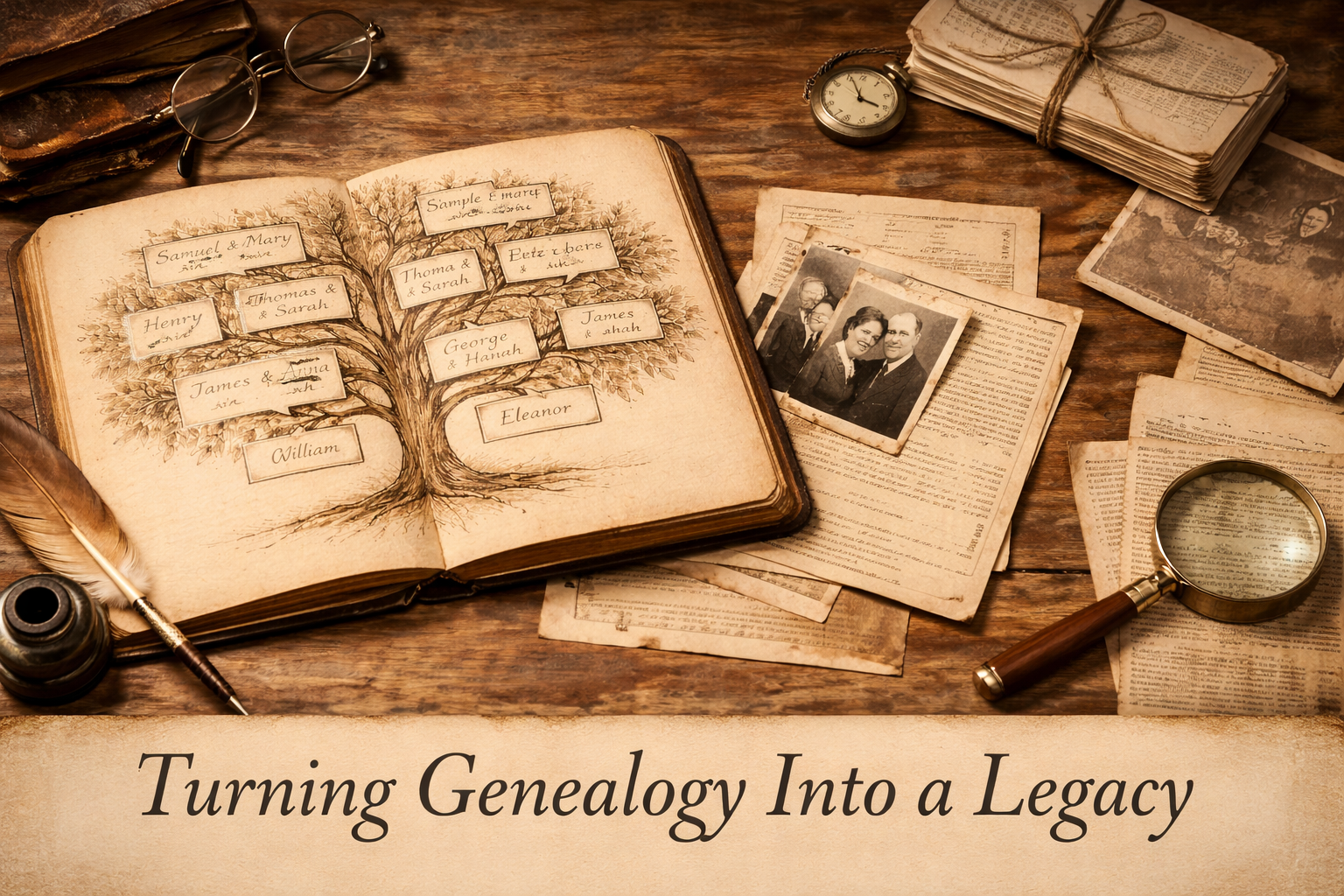
Posted on March 25, 2026 · By Echoes of Kin Genealogy
How to Create a Meaningful Family History Book
Have you ever closed a genealogy program after hours of research and thought, “What happens to all of this when I’m gone?”
Family history research often lives in charts, folders, and digital trees. But our ancestors’ lives — their work, their struggles, their relationships — deserve more than a database entry. They deserve to be remembered in a way that feels human and lasting.
Creating a family history book is one of the most meaningful ways to turn research into a legacy future generations can hold in their hands.
What Is a Family History Book?
A family history book is more than a list of names and dates. It’s a thoughtfully organized collection of:
- Stories drawn from documented records
- Photographs and heirloom images
- Historical context that explains how ancestors lived
- Charts and timelines that clarify relationships

At its heart, it’s about transforming research into something readable, personal, and enduring.
Records like this remind us that names become meaningful when we understand the lives behind them.
Why This Matters in Family History
Genealogy often answers the question “Who were they?”
A family history book helps answer “What was life like for them?”
It connects:
- Past generations to living relatives
- Historical events to personal experiences
- Records to real human stories
Behind every census line or marriage record was a person who worked, loved, worried, hoped, and built a life that shaped the family you know today.
When we preserve those stories in a book, we make it easier for future generations to understand where they come from — and why it matters.
What to Include in a Family History Book
Core Genealogy Information
- Family group sheets
- Pedigree charts
- Birth, marriage, and death details (with sources)
Narrative Sections
- Ancestor profiles grounded in records
- Migration stories based on documented moves
- Descriptions of occupations and communities

Historical Context
- Maps of where families lived
- Short explanations of major events that shaped their lives
- Social and cultural background relevant to their time and place
Visual Elements
- Scans of photographs
- Images of signatures or handwriting
- Copies of meaningful documents
These small details often hold the biggest stories.
How This Shows Up in Real Research
Many researchers have extensive notes but struggle to share them meaningfully.
For example:
A family might know their great-grandparents immigrated in the early 1900s. The records show ship manifests, naturalization papers, and city directories. On their own, those documents feel technical.
Or perhaps you’re tracing a German-speaking ancestor whose name shifts spelling across records, or a Revolutionary War soldier who appears in a pension file decades after his service. The documents exist. The details are there. Yet without context, they can feel distant.
In a family history book, those same records become part of a narrative:
- Why they left
- Where they settled
- What work they did
- How their community grew
The research doesn’t change — but the way it’s presented makes the story accessible and memorable.
Steps to Start Your Family History Book
1. Choose a Focus
Start small if needed:
- One family line
- One generation
- One immigrant story (For example, a book focused solely on your ancestor’s journey from German to the American Midwest.)
You can always expand later.
2. Organize Your Material
Gather:
- Documents
- Photos
- Timelines
- Research notes
Group them by family or time period.
3. Write in Short, Clear Sections
Aim for:
- 2–4 paragraphs per ancestor profile
- Clear headings
- Simple explanations of historical context
Avoid overwhelming readers with too many dates at once.
4. Add Context, Not Assumptions
Instead of guessing feelings or motives, explain:
- What the records show
- What daily life was like in that place and time
- How events may have shaped available choices
Behind this document was a person who lived within the limits and opportunities of their time.

Common Mistakes to Avoid
- Writing only for genealogists instead of family members
- Including every document instead of the most meaningful ones
- Using too much technical language
- Skipping source citations (future researchers will thank you)
The Emotional Impact of a Family History Book
A printed book has a different presence than digital files.
It can be:
- Passed down
- Read by children and grandchildren
- Displayed on a shelf
- Shared at reunions
A physical book also allows for a kind of shared discovery that a laptop screen simply can’t provide. Sitting together on a couch, flipping pages, pausing over a photograph, rereading a paragraph aloud — that experience feels different than scrolling through a tree online. It invites conversation. It invites memory.
It becomes not just a research project, but a family heirloom.
Records like this remind us that preserving memory is an act of care across generations.
A Gentle Invitation
If you’ve been researching for years, consider taking the next step: turn your work into something your family can read, hold, and treasure.
You don’t have to finish it all at once. Start with one branch, one story, one generation.
Legacy isn’t built in a single moment — it’s built one remembered life at a time.
✨ Thinking about creating your own family history book? Not sure how to bridge the gap between your research and a finished book? Whether you’re working with German immigration records, Revolutionary War pensions, or decades of carefully gathered documents, I offer free consultations and narrative writing services to help you turn your files into a family heirloom.
Follow along with Echoes of Kin Genealogy for more guidance on turning research into lasting legacy.
Leave a Reply