Posted on August 17, 2026 · By Echoes of Kin Genealogy
KEY TAKEAWAYS
- More Than an Endpoint: A death certificate contains clues about parents, birthplaces, occupations, residences, burials, and family relationships that can open new branches of your tree.
- Evaluate the Informant: Not every statement carries the same weight. Ask who supplied each piece of information and how likely they were to have firsthand knowledge.
- Investigate Discrepancies: Treat unexpected details as questions to investigate rather than facts to accept automatically or mistakes to dismiss too quickly.
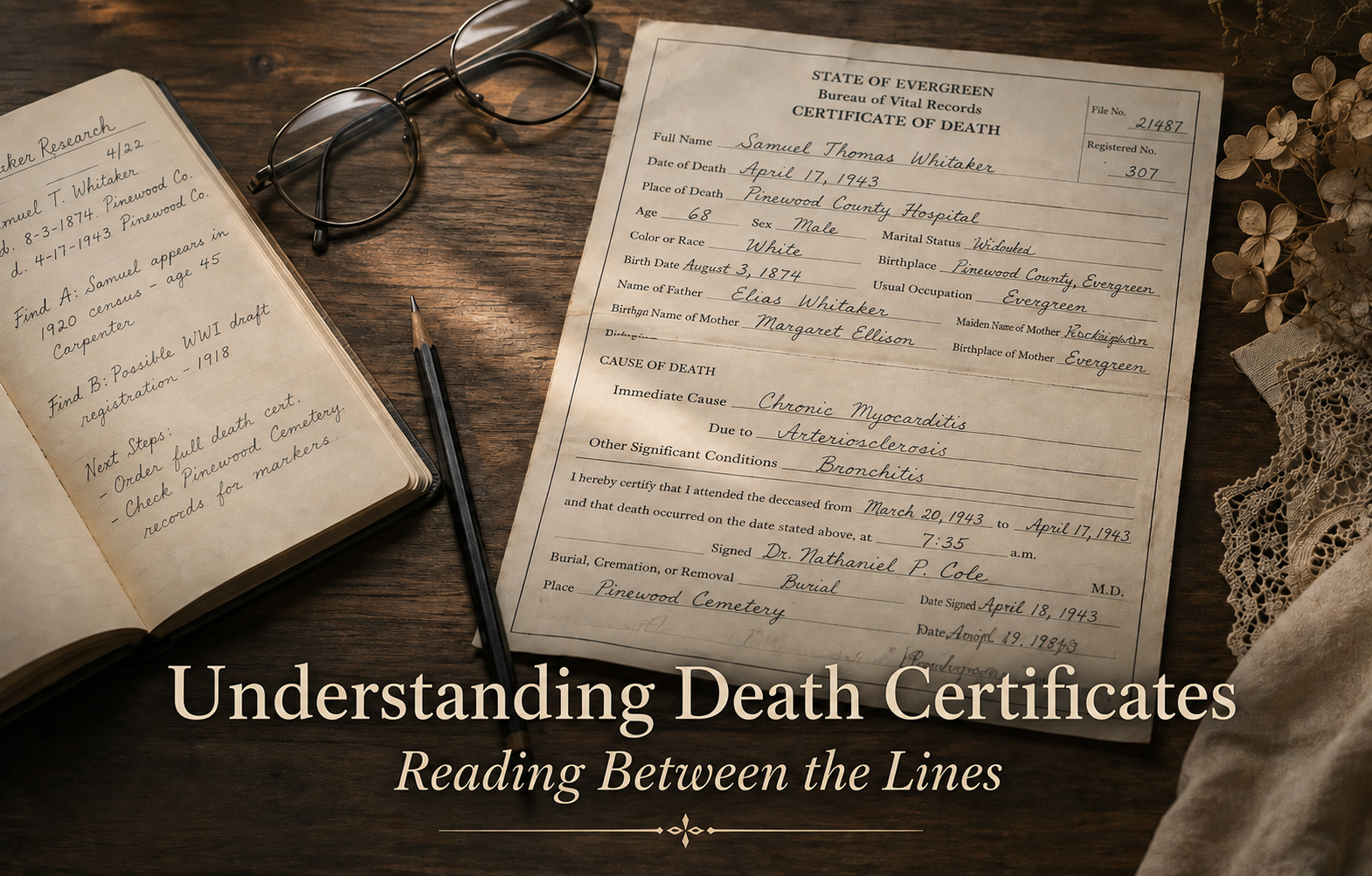
There is something unusually quiet about reading an ancestor’s death certificate.
At first, our eyes tend to settle on the obvious things: the name, the date, the place, the cause of death. Perhaps those are the facts we came looking for. Yet after a while, another name catches our attention: a parent we did not know about, an unfamiliar birthplace, or an occupation that places our ancestor in a different setting than we had imagined.
Then we notice the informant.
Suddenly, the certificate is no longer simply a record of someone’s death. It is also a record created by living people at a particular moment, using what they knew, what they remembered, and sometimes what they did not know at all.
For genealogists, that distinction matters.
A Death Certificate Is a Beginning, Not an Ending
Death certificates are often treated as endpoint records. We find one, enter the date and place of death into our family tree, cite the source, and move on.
I think they deserve a slower reading.
Depending on the time and jurisdiction, a death certificate may include the deceased person’s age, marital status, spouse, usual residence, occupation, birthplace, parents’ names and birthplaces, burial location, medical information, and the identity of the person who supplied personal details.
Each field has the potential to lead somewhere else:
- An occupation could suggest employment records, trade unions, or city directories.
- A burial place might lead to cemetery plot deeds, obituaries, or relatives buried nearby.
- A mother’s maiden name could open an entirely new branch of the family.
But there is an important caution hiding among all those details: information appearing on an official document is not automatically correct simply because the document is official.
That does not make the certificate unreliable. It means we need to understand how the information got there.
Start With the Informant
One of the first places I look on a death certificate is the informant line.
The informant was the person who provided at least some of the personal information used to complete the record. Depending on the certificate, that might have been a spouse, adult child, sibling, another relative, hospital representative, institution employee, or neighbor.
That person’s relationship to the deceased can radically change how we evaluate what we are reading.

Imagine a certificate for a woman named Clara Mae Bennett, who died in Ohio in 1937 at age 81. Her son, Thomas, is listed as the informant.
Thomas probably knew his mother’s married name. He likely knew where she had been living, and he may have known his own father’s name quite well. But Clara’s parents? They may have died decades before Thomas was born.
If Thomas reported that Clara’s mother was “Mary Wilson, born in Pennsylvania,” we have a valuable clue. Still, we should hesitate before treating those details as proven facts—Thomas was reporting information about an event and generation he did not personally witness.
That small distinction is part of good genealogical reasoning.
Ask Who Could Have Known
When evaluating information on a death certificate, consider:
- Who supplied this information?
- What was that person’s relationship to the deceased?
- Were they likely to have firsthand knowledge of the fact?
- How much time had passed since the event being described?
- Does another record created closer to that event agree?
In historical research, a record created closer to an event will generally be more trustworthy for information about that event. A birth or baptismal record created in infancy is usually stronger evidence for someone’s birth details than a death record created eight decades later.
We don’t throw away the later information—we simply give it the weight it deserves.
Read Every Line, Including the “Boring” Ones
Genealogical breakthroughs have an annoying habit of hiding in fields that did not seem important the first time we looked.
Take “usual residence.” It is easy to focus on the place of death instead, but a person could die in a hospital several towns away while their actual home was somewhere else. That residence points toward city directories, newspapers, church membership, property records, voter registrations, or household members in census years.
Occupation deserves attention, too. “Laborer” may seem generic, but “Machinist, railroad shops” opens a specific door. Now there may be an employer, a workplace, or railroad employment and pension records to investigate at the National Archives or historical societies.
Even burial information can change the direction of a search. If the certificate identifies a cemetery you have never encountered, do not stop after locating the grave. Look at the surrounding burials, search cemetery lot cards, and ask whether a family plot existed. Surnames appearing two plots away are rarely strangers!
Parents’ Names: Handle With Care
For researchers trying to cross into an earlier generation, the parents’ section can be irresistible. There it is—a mother’s maiden name! Perhaps it is the first time you have ever seen it.
💡 Michelle’s Pro-Tip: The “Firsthand Knowledge” Check
“Before adding a newly discovered set of great-grandparents to your online tree based solely on a death certificate, ask yourself: Was the informant alive when these parents were married? If an adult child or grandchild listed the mother’s maiden name, treat it as a working hypothesis until you cross-verify it against the parents’ actual marriage record, church registers, or land deeds.”
Suppose your ancestor’s death certificate gives his mother as “Elizabeth Carter.” A census record from his childhood appears to show a mother named Eliza, while a sibling’s death certificate calls her “Elizabeth Carver.”
That is not the moment to pick whichever surname appears most often. It is time to investigate. Compare the informants on all siblings’ death certificates. A marriage record created when Elizabeth herself was present carries very different evidentiary weight than information supplied decades later by a grandchild.
A discrepancy is not a research failure—it is the beginning of a better question.
Cause of Death: Read the Sequence
The medical section can be intimidating on older certificates. Handwriting may be difficult, terminology changes over time, and several medical conditions may appear together.
One helpful distinction is between an underlying cause of death and contributing conditions:
- Underlying Cause: The disease or injury that initiated the chain of morbid events leading directly to death.
- Contributing Conditions: Secondary health conditions that played a role but did not cause the primary chain of events.
If several conditions appear on the certificate, avoid reducing the entire story to whichever phrase catches your eye first. Transcribe what the record actually says before interpreting what it might mean.
What Are Those Numbers Near the Cause of Death?
Researchers sometimes discover handwritten or typed numbers stamped near the medical information. These are classification codes from the International Classification of Diseases (ICD), used by health departments to standardize mortality statistics.
That last point is critical for genealogists: do not automatically look up an old code in today’s ICD system.

Different ICD revisions were used during different historical periods. For example, in the United States:
- ICD-9 was used from 1979 through 1998.
- ICD-10 began in 1999.
- Earlier decades utilized revisions (ICD-1 through ICD-8) specific to those years.
If you encounter a code on a historical death certificate, first determine which classification revision was active in that state or country during that specific year. That little number can be a lifesaver when trying to decipher obscure medical handwriting!
Notice What Is Missing
Blank spaces deserve attention, and “Unknown” deserves attention, too.
If the informant knew the father’s name but listed the mother’s maiden name as “Unknown,” that tells us something about the limits of the informant’s knowledge—it does not tell us that the mother cannot be identified. Likewise, a blank birthplace should never quietly become “probably the same place as the rest of the family.”
Leave the uncertainty intact. Genealogy gets stronger when we allow a record to say I don’t know.
Build a Small Evidence Table
When a death certificate contains important ancestral claims, separate those claims before evaluating them:
| Information Field | What Certificate Says | Likely Source/Informant | Next Record to Check |
| Date of Death | May 14, 1924 | Attending Physician/Official | Cemetery record, Funeral home file |
| Birthplace | Kentucky | Informant (Adult Daughter) | Census rolls, Church/birth records |
| Father’s Name | Henry Reed | Informant (Adult Daughter) | Marriage license, Census, Probate |
| Mother’s Name | Unknown | Informant (Adult Daughter) | Siblings’ death certificates, Church records |
| Occupation | Carpenter | Informant/Recent knowledge | City directories, Union records |
| Burial Place | Belleview Cemetery | Undertaker/Informant | Cemetery lot register, Plot map |
This simple exercise keeps us from treating every statement on the certificate as equally reliable, while showing us exactly where to search next.
The Human Being Behind the Form
There is another reason death certificates deserve to be read slowly: behind every box and handwritten line was a person.
- “Occupation: Laundress” represents decades of physically demanding work.
- “Residence: 42 years” means someone stayed in one community while children grew up, neighbors came and went, and a town changed around them.
- A daughter’s signature as informant isn’t just a source-quality metric—it places that daughter in the room during the final administrative moments of her mother’s life.
We should not invent emotions the record does not document, but we can recognize her presence. That is one of the quiet privileges of family history: we study evidence carefully while remembering that the evidence exists because real people lived the lives we are trying to understand.

Before You Close the Record
The next time you find an ancestor’s death certificate, resist the urge to extract the date and move on. Read it once for facts, then read it again for questions:
- Examine the informant’s relationship.
- Investigate the residence and occupation in local directories.
- Transcribe medical sequences accurately and check the ICD revision year for stamped codes.
- Follow the cemetery location to surrounding graves.
Most importantly, separate what the certificate says from what the certificate proves.
Death certificates record the end of a life, but for genealogists, they are often where the real story begins. Take your time, question the informant, and follow every clue.
Warmly,
Michelle Bruner
Genealogist & Founder, Echoes of Kin Genealogy
Helpful Official Resources
- CDC Guide to Cause of Death Reporting: Explains underlying vs. contributing medical causes.
- CDC ICD Revision History Table: Helps researchers identify which historical ICD classification corresponds to specific death years.
- FamilySearch Research Wiki: Guide for locating vital records, death indexes, and cemetery databases by county and state.
Try This With One Ancestor
Choose one death certificate already in your files and give it another reading using the Evidence Table method above. Did you uncover an unexpected clue, conflicting birthplace, unfamiliar medical code, or mystery informant? Share your discovery in the comments below!
Leave a Reply