Posted on April 29, 2026 · By Echoes of Kin Genealogy
There is something strangely intimate about opening a DNA match list for the first time.
You are not just looking at names, centimorgans, and little colored dots. You are looking at traces of connection. Some are close and obvious. Others sit quietly on the screen with unfamiliar surnames and no family tree at all, waiting for context. For family historians, that can feel exciting, unsettling, hopeful, and a little overwhelming at once. A match list is not a family tree by itself, and it does not hand over answers in neat order. Still, when read carefully, it can open doors that paper records alone sometimes leave closed.
In my own research, I’ve seen how DNA match lists bridge the miles. A match found in a Las Vegas database might suddenly connect to a cluster of families in a small Nebraska township in the 1880s. The DNA does not care about the long drive across the plains. It simply preserves the shared inheritance that began in that farmhouse generations ago.
DNA match lists matter because they bring real people into view. They can help confirm a suspected line, point toward an unknown parent or grandparent, separate families with similar names, or reveal that the story passed down at the kitchen table needs a gentler second look. This is where genetic genealogy becomes more than data. It becomes a way of understanding how one life touches another across time.
What Is a DNA Match List?
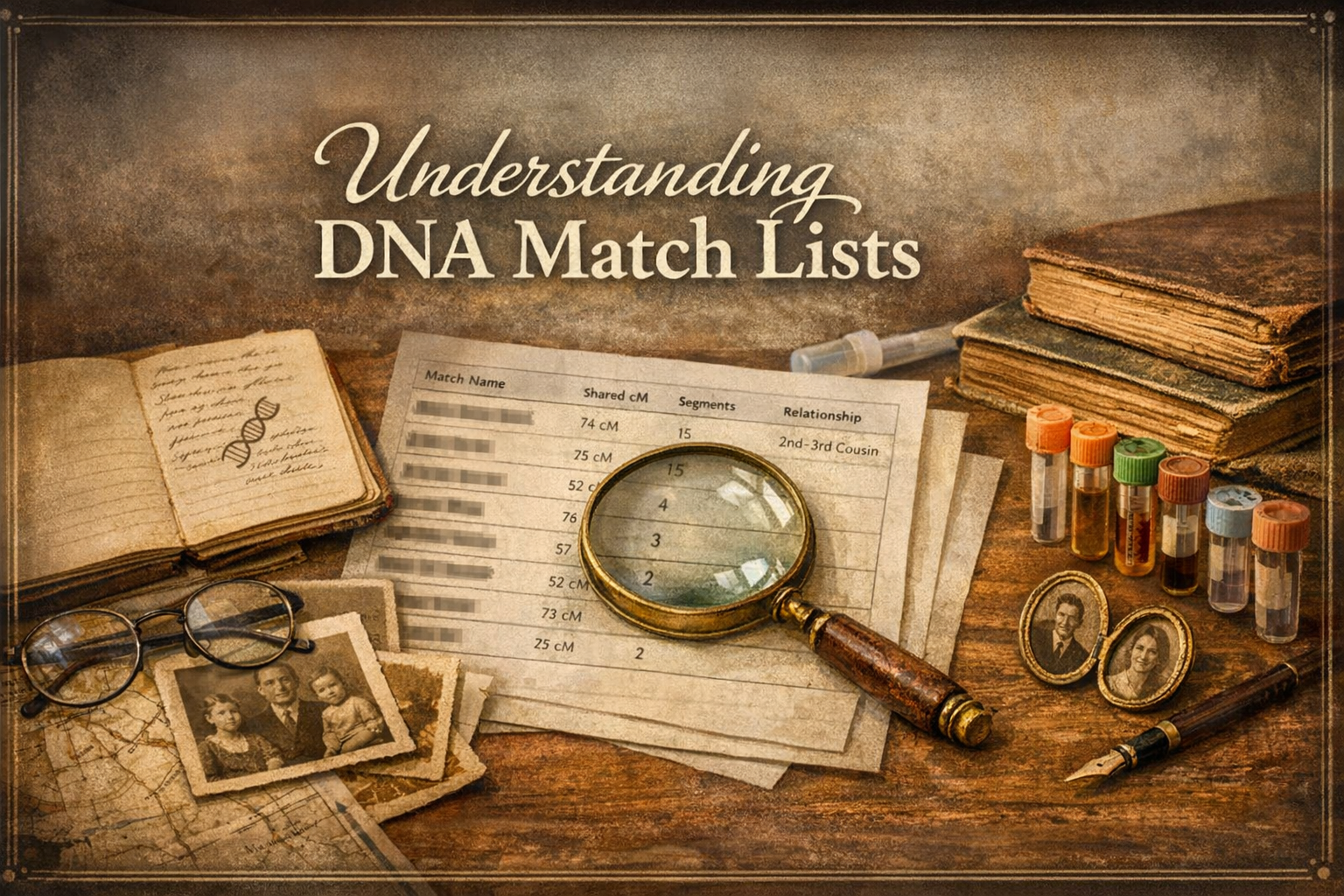
A DNA match list is the roster of people who share enough DNA with you to suggest a common ancestor. Testing companies compare your DNA to that of other testers and estimate how closely you may be related.
Usually, a match list includes:
- The match’s username or name
- The amount of shared DNA, often measured in centimorgans or cM
- The number of shared DNA segments
- An estimated relationship range
- Shared matches
- Family tree details, if the match has provided them
- Notes, group labels, or color tags depending on the platform
At first glance, it can look very technical. In practice, though, a match list is less like a spreadsheet and more like a set of clues. No single entry tells the whole story. Meaning comes from patterns.
Why Centimorgans Matter
The amount of shared DNA is usually shown in centimorgans, abbreviated as cM. This is one of the first numbers people notice, and for good reason. In general, the more DNA you share with someone, the closer the relationship is likely to be.
A parent and child share a very large amount of DNA. A second cousin shares much less. A more distant cousin may share only a modest amount, sometimes small enough that the connection is difficult to identify with confidence.
Still, cM is not a perfect measuring stick. Relationship ranges overlap. A person sharing 230 cM with you might be a great-grandparent’s niece’s descendant in one family context and something slightly different in another. That uncertainty can frustrate beginners, but it is normal. DNA gives ranges and probabilities, not tidy labels carved in stone.
This is one reason experienced researchers do not stop at the number. They look at the whole cluster around it.

Match Lists Are About Patterns, Not Just Individuals
One of the most useful mindset shifts in genetic genealogy is this: do not look only at one match at a time. Look at how matches relate to each other.
Imagine you have a match named Linda who shares 145 cM with you. She has no tree. That alone may not seem especially useful. But then you notice that Linda shares matches with three known descendants of your maternal great-grandparents from Kentucky. Suddenly Linda is no longer a mystery floating alone. She is part of a group.
That is how match lists begin to speak more clearly.
When several matches connect to each other and to a known family line, they often form a cluster. That cluster may represent one branch of your family. Over time, as you identify more of these groups, the match list becomes easier to read. You begin to see which relatives likely belong on your mother’s side, your father’s side, your grandmother’s German line, or the branch that moved from North Carolina into Tennessee.
Shared Matches Can Change Everything
Most major DNA platforms offer a shared matches feature. This shows people who match both you and another person. It is one of the most practical tools on the page.
Shared matches can help you:
- Separate maternal matches from paternal ones
- Group cousins into family branches
- Focus on the most promising research paths
- Avoid chasing a match who belongs to the wrong side of the family
Let’s say you recognize a known second cousin on your father’s side. If you open that cousin’s shared matches, you may see a whole set of people who likely connect through the same paternal line. Even if half of them have private trees or unfamiliar names, they now have context.
That context is often more valuable than the match alone.
A Match With No Tree Is Not a Dead End
This is one of the most discouraging parts of DNA research for many people. You find a promising match, click eagerly, and discover there is no family tree. Or the tree has three people in it. Or the username is something like “SunflowerMoon72,” which does not exactly narrow things down.
Even so, a tree-less match is not useless.
You can still learn from:
- Shared matches
- The amount of shared DNA
- The match’s ethnicity estimate, cautiously used
- Their location, if listed
- Their username, if it appears elsewhere
- Whether they respond to messages
- Notes you build over time as new evidence appears

Sometimes the breakthrough comes months later. A match who was impossible to place in January may make sense in August after you identify two more cousins in the same cluster. This slow unfolding is part of the work. It asks for patience, which is not always easy, especially when the question is deeply personal.
What DNA Match Lists Can Help You Do
DNA match lists can support many kinds of family history research. They are especially useful when records are incomplete, names are repeated across generations, or family stories are fragmentary.
They may help you:
Confirm a Paper Trail
If your documentary research suggests that your third-great-grandparents were John and Eliza Carter of southern Ohio, DNA matches descended from their children may help support that conclusion. DNA does not replace records, but it can strengthen a case built from census records, probate files, land deeds, and church registers.
Identify Unknown Parents or Grandparents
For adoptees, people with misattributed parentage, or families carrying long-standing uncertainty, match lists can become central evidence. In these cases, clustering, shared matches, and careful tree-building are often more useful than ethnicity estimates.
Sort Out Families With the Same Names
Anyone who has worked in nineteenth-century records knows how often names repeat. Two men with the same name may live in the same county at the same time. DNA matches can sometimes help distinguish one family from another by showing which descendants consistently appear together.
Reconnect Living Families
Not every discovery is dramatic. Sometimes a match list simply helps cousins find one another, share photographs, compare research, or recover the name of a woman who had nearly disappeared from family memory except as “Aunt Kate, maybe.”
That kind of restoration matters too.
What Match Lists Cannot Tell You on Their Own
DNA is powerful, but it has limits. Match lists do not provide a full family tree automatically, and they do not interpret themselves.
A match list cannot, by itself:
- Name the exact common ancestor in every case
- Tell you which side of the family a match belongs to without context
- Replace documentary research
- Explain family secrets with emotional sensitivity
- Guarantee that every predicted relationship is correct
This matters because people can be tempted to overread the evidence. A cluster may strongly suggest a connection, but good genealogy still asks for multiple forms of support. Family historians do their best work when they combine DNA evidence with records, timelines, local history, and careful reasoning.

A Gentle Word About Emotional Weight
Not every DNA match list is just a research tool.
Sometimes it is the first place someone sees evidence that a parent may not be who they expected. Sometimes it confirms a long-held suspicion. Sometimes it offers a possible connection to relatives who never knew a person existed. And sometimes, after years of searching, it gives a name to a line that had gone silent.
That can be tender territory.
It helps to remember that the people in your match list are not simply data points. They are living people with their own histories, surprises, loyalties, and limits. A thoughtful approach matters. So does restraint. Not every discovery should be rushed, and not every match will be ready for the same conversation you are ready to have.
In genealogy, evidence and empathy belong together.
Practical Tips for Reading a DNA Match List
When the screen feels crowded, it helps to slow down and use a simple process.
Start With the Closest Known Matches
Identify relatives whose place in your tree is already documented. These known matches can anchor the list and help you sort others by side and branch.
Use Labels or Color Group
If your testing platform allows notes, dots, or custom groups, use them. Mark maternal and paternal lines first. Then get more specific as patterns emerge.
Build Small Research Trees
You do not need to build out every match completely. Sometimes a quick tree for a match’s parents, grandparents, or great-grandparents is enough to identify a shared ancestral couple.
Focus on Clusters
A group of moderately strong matches with the same shared-match network is often more useful than one isolated match with slightly higher cM.
Keep a Research Log
Write down what you tested, what you suspect, and what still feels uncertain. This prevents circular research and helps you revisit old matches with clearer eyes later.

Common Mistakes Beginners Make
Many of us make the same early missteps, especially when the match list feels urgent.
Here are a few to watch for:
- Treating ethnicity estimates as stronger evidence than match clustering
- Assuming the predicted relationship is exact
- Ignoring matches with no trees
- Focusing only on the highest cM match
- Forgetting that shared matches may reflect only part of the relationship picture
- Reaching out to relatives with conclusions before the evidence is ready
That last one deserves special care. It is understandable to feel eager when a possibility appears. Still, a measured message such as “I think we may share ancestors in this line, and I’d be glad to compare notes if you’re open to it” often goes much farther than a dramatic announcement.
Why This Matters in Family History
A DNA match list can look impersonal at first. Numbers. Labels. Percentages. Tiny profile icons.
Then, gradually, it changes.
You begin to realize that the cluster you labeled “Morrison line” may represent descendants of a widow who kept her family together after the Civil War. A match tied to a mining town might explain why one branch disappeared from the county records you knew so well. A stranger’s tree may hold the maiden name your great-aunt never quite remembered. In my own research, I’ve seen how that shift can happen almost without warning. A match sitting in a Las Vegas database can lead back to a web of families in a Nebraska township from the 1880s, as if the distance between them were meaningless. In some ways, it is. DNA does not remember highways or state lines. It remembers inheritance.
The list becomes less about data and more about people whose lives were complicated, ordinary, difficult, brave, interrupted, and deeply connected to your own.
That is why understanding DNA match lists matters. Not because the tools are flashy, and not because every mystery will be solved. It matters because these lists can help us place people back into relationship with one another. They can recover context. They can correct errors. They can also remind us that family history is rarely neat.
Sometimes it is a puzzle. Sometimes it is grief with names attached. Sometimes it is joy.
Usually, it is both.
Final Thoughts
You do not need to understand every feature on a DNA platform in one sitting. Start by learning how to read the match list in front of you. Notice the cM amounts. Study shared matches. Group people carefully. Build context one branch at a time.
Over time, what first looked like a wall of strangers may begin to feel more like a map.
And maps, even imperfect ones, can help us find our way back to people we have been trying to understand for a very long time.
Leave a Reply