Posted on April 13, 2026 · By Echoes of Kin Genealogy
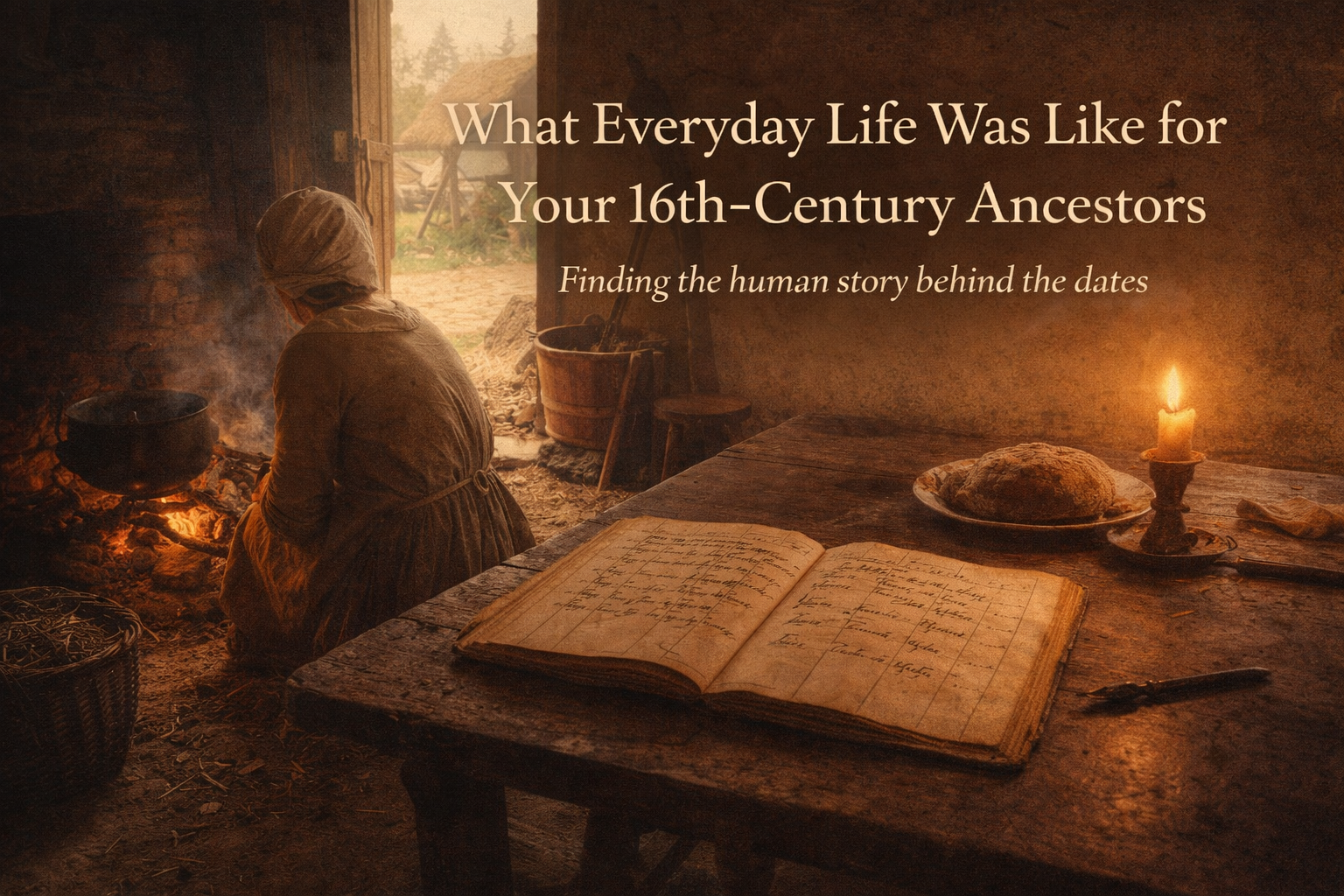
Finding the human story behind the dates
There is something humbling about tracing a family line back to the 1500s. The names become sparse. The records thinner. A baptism in 1582. A marriage with no ages listed. A burial entry that offers only a surname and a parish.
And yet, behind those spare lines in a parish register, there was a living, breathing person.
They woke to the smell of smoke from a hearth fire. They worried about harvest yields. They carried water by hand. They loved, argued, endured winter illnesses, and buried children far more often than we can comfortably imagine. When we pause long enough to picture their daily life, genealogy stops being abstract and becomes personal.
Today, let’s step gently into the world of our 16th-century ancestors and consider what everyday life may have looked like for them, especially if your research points to rural Europe.
A World Without Electricity, Plumbing, or Privacy
If your ancestors were not nobility, and most were not, they likely lived in a small village or market town. Homes were simple structures made of timber, stone, or wattle and daub. The hearth was the center of the house. It provided warmth, light, and the place where meals were prepared.
Privacy as we know it did not exist. Families often slept in one room. Beds might be shared by several children. Livestock sometimes occupied space under the same roof during winter.

Water came from a well or nearby stream. It had to be carried. Every bucket mattered.
Clothing was practical. Wool for warmth. Linen for undergarments. Garments were patched and repurposed repeatedly. A single outfit might serve for years.
When we find an ancestor listed simply as “laborer” in a parish record, that word hides a life structured around physical endurance.
Work Shaped the Rhythm of the Year
Most 16th-century families lived by the agricultural calendar. Spring meant planting. Summer required long days in the fields. Autumn brought harvest and, with it, relief or anxiety depending on yields. Winter narrowed life indoors.
For many in England, parts of Germany, France, Scandinavia, or Spain, labor was tied to land held under feudal systems that were slowly changing during this century. In England, for example, the Tudor period saw economic shifts and enclosure movements that altered rural life in subtle but lasting ways.
Even children worked.
By age seven or eight, they contributed to household survival. Tending animals. Gathering firewood. Helping with spinning or weaving. Childhood, as we think of it today, was not yet its own protected stage of life.
And that matters when we consider a 14-year-old bride or a 16-year-old father in our tree. It feels startling to modern eyes. But responsibility began early.

Faith Was Not a Sunday Activity
The 1500s were a century of religious upheaval across Europe. The Protestant Reformation reshaped communities. Parish loyalties shifted. In some regions, families faced pressure to conform or risk penalty.
But beyond politics, church life marked the milestones we now depend on as genealogists.
Baptisms were often recorded within days of birth because infant mortality was painfully high. Marriages were public and communal. Burials sometimes happened quickly, particularly during outbreaks of disease.
When we hold a transcription of a 1589 baptism, we are looking at a record created in a community where faith structured time itself. Feast days, fasts, saints’ days, market days, all intertwined.
For us, parish registers are research tools. For them, the church was the center of meaning and belonging.
Health Was Fragile and Uncertain
Life expectancy statistics from the 16th century can be misleading. Many adults who survived childhood lived into their 50s or 60s. The true danger was early mortality.
Common threats included:
- Smallpox
- Plague outbreaks in urban areas
- Malnutrition during failed harvests
- Childbirth complications
Medical knowledge was limited. Remedies were often herbal or based on humoral theory. A fever could become fatal within days.
If you have noticed multiple burials for children with the same surname within a short span of years, you are likely seeing the shadow of this reality.
It is difficult to sit with that. Still, it deepens our understanding of resilience. A woman who bore eight children and saw four survive was not unusual. She was living within the norms of her time.

Community Was Everything
In the absence of modern institutions, neighbors mattered.
Villagers shared tools. They helped harvest crops. They witnessed marriages and disputes. Reputation carried weight. A single accusation could ripple through generations.
If your 16th-century ancestor appears repeatedly in court rolls or manorial records, that may reflect land disputes, inheritance questions, or minor conflicts over boundaries. These were not necessarily signs of scandal. They were signs of participation in community life.
Research tip: If you are tracing ancestors in England, look beyond parish registers to manorial court records, tax lists such as the Subsidy Rolls, and wills proved in ecclesiastical courts. These documents often reveal occupations, property, and kinship networks that parish entries omit.
Why This Matters in Family History
It is easy to treat the 1500s as distant and almost medieval in feeling. Yet these people are not abstractions. They are the reason we are here.
When we understand:
- Why children married young
- Why names were reused after a child’s death
- Why migration occurred during enclosure or religious change
- Why a widow remarried quickly
We stop judging the past through modern assumptions. We start interpreting records with empathy.
I once worked with a client whose earliest proven ancestor married in 1574 in a small English parish. For years, that entry felt like a thin thread. Then we studied grain prices during that decade and discovered a series of poor harvests. Suddenly, the move his son made to a nearby market town felt less random. It felt strategic. Human.
Context transforms data into story.
Bringing 16th-Century Ancestors to Life in Your Research
Here are practical steps you can take:
1. Study Local History
Look for regional histories covering the 1500s. Understanding land use, religious shifts, and economic pressures in your ancestor’s county or province adds dimension.
2. Map the Village
Even a simple sketch helps. Where was the church? The fields? The nearest market town? Physical space shapes daily life.
3. Explore Occupational Clues
Terms like “husbandman,” “yeoman,” or “cottar” carry specific economic meanings. Research them within the time period rather than applying modern definitions.
4. Read a Will Slowly
A 16th-century will may list livestock, tools, bedding, and cookware. These items are windows into the household environment.
A Gentle Reminder
We will never know the full texture of their inner lives. The 16th century does not leave us diaries for most ordinary families. What it leaves instead are fragments.
Still, fragments can be enough.
When you next look at a 1570s marriage record, pause. Imagine the sound of boots on packed earth. The murmur of neighbors gathered in a stone church. The weight of responsibility resting on young shoulders.
Genealogy is not only about reaching further back. It is about looking more closely.
If you have traced your line into the 1500s, I would love to hear what you have discovered. What small detail made your ancestor feel real to you?
Share your story in the comments, or reach out if you would like help placing your early ancestors into historical context. At Echoes of Kin Genealogy, we honor names on a page by remembering they once stood in the warmth of a hearth, planning for tomorrow.
Leave a Reply