Posted on October 26, 2026 · By Echoes of Kin Genealogy
KEY TAKEAWAYS
- Discrepancies are normal in family history. Conflicting records do not automatically mean one source is useless; historical documents reflect human memory, shifting boundaries, and distinct record-keeping purposes.
- A record is not the same thing as the information inside it. A single document can contain firsthand eyewitness facts alongside second-hand recollections. Every piece of information must be evaluated on its own merits.
- Correlate sources instead of counting them. Ten online family trees repeating the same date represent an echo chamber, not ten independent pieces of corroborating proof.
- Solid conclusions explain contradictions openly. High-standard genealogy does not hide inconvenient records; it explains why one source carries more weight or clearly acknowledges what remains uncertain.
There is a certain kind of genealogy discovery that can make even an experienced researcher stare at the screen a little longer than usual. You find a death certificate for an ancestor you have been researching for weeks. Everything seems right: the spouse matches, the residence matches, and the occupation fits.
Then you see the birth date.
It is three years different from the date written in the family Bible, and the federal census gives yet another year entirely. Suddenly, what seemed settled is not settled at all.
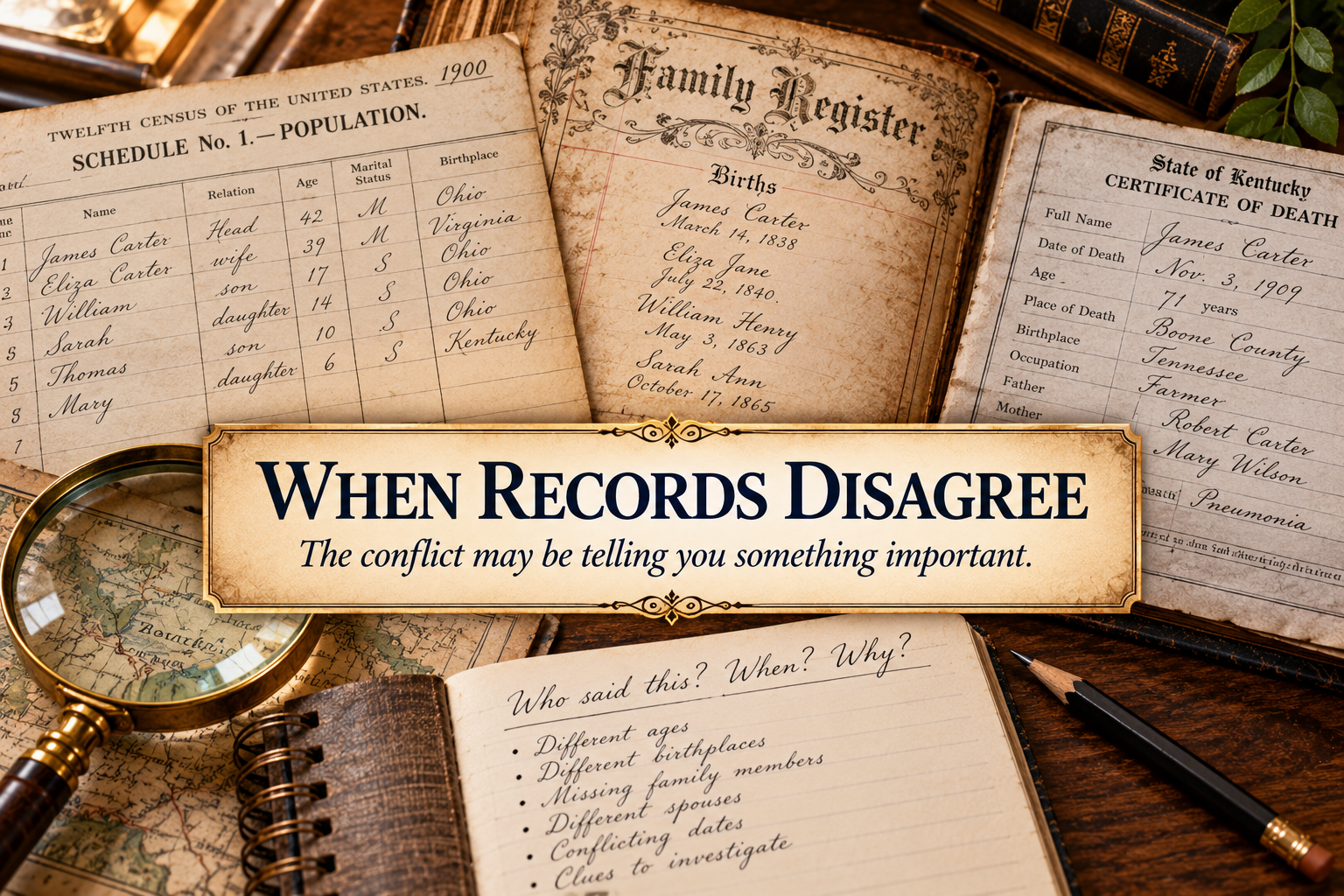
This is the crossroads where genealogy shifts from collecting names into true evidence analysis. When historical sources disagree, the question is no longer simply, “Which date is the right one?”
Instead, we must ask something far more productive: Who provided each piece of information, how did they know it, and what other evidence supports or challenges their statement?
In family history, answering those questions matters far more than finding the largest number of records that happen to say the same thing.
Conflicting Evidence Is Normal
It can be unsettling to discover that records disagree, particularly when modern genealogy software encourages us to assign every ancestor one clean birth date, one birthplace, and one static spelling of their name. Real-world archival records are rarely that tidy.
An ancestor might be recorded as born on March 15, 1881, on a delayed birth application, listed as born in March 1880 in the 1900 census, reported as age 38 in 1920, and memorialized with an 1879 birth year on their gravestone. None of this is unusual.
Historical documents were created by living people in real time. Someone answered the questions, and someone else wrote down the answers. Sometimes dates were recalled decades after the event, ages were estimated by well-meaning neighbors, clerks misheard accented surnames, and informants simply did not know the truth.
A record can be completely genuine and still contain inaccurate information.
That distinction is critical. The question is never whether an archival document is “official.” The real question is whether the specific statement inside that document is reliable for the research problem you are trying to solve.
A Record Is Not the Same Thing as the Information Inside It
One of the foundational principles of genealogical analysis is recognizing that a single document often contains information of vastly different quality.
Consider a standard county death certificate. On that single sheet of paper, you will find the date and place of death, the decedent’s age or birth date, their birthplace, parents’ names, spouse, occupation, and cause of death. Those details were not supplied by the same person, nor were they known with the same degree of certainty.
The attending physician provided the medical cause and exact time of death, which they witnessed firsthand. In contrast, personal details like the decedent’s birth date or mother’s maiden name were supplied by an informant—often a grieving adult child or grandchild who was born decades after the events occurred.
Same document. Entirely different levels of evidence.
Professional researchers evaluate information statement by statement, rather than labeling an entire document “reliable” or “unreliable.”

Start With the Most Important Question: Who Knew?
Imagine trying to determine the birth year of a woman named Clara Bennett. Across your research, you locate four distinct sources:
| Source | Reported Birth Information | Informant & Proximity |
| 1900 Federal Census | February 1871 | Household member; 29 years post-event |
| 1910 Federal Census | Age 37 (suggests c. 1872–1873) | Unknown respondent; 38 years post-event |
| Death Certificate | 14 February 1870 | Adult daughter; 75 years post-event |
| Family Bible | 14 February 1871 | Contemporary family entry |
It is tempting to treat this like a vote: two sources point toward 1871, one gives 1870, and another suggests 1872 or 1873. Does 1871 “win” by majority rule?
Genealogical proof does not work by democratic vote. Before accepting any date, we have to interrogate the origins of each entry.
Who spoke to the census enumerator on that hot day in 1910? The enumerator may have spoken to a teenage son, a boarder, or a neighbor across the fence. Who reported the details on Clara’s death certificate? Her daughter, who had to recall her mother’s precise birth year while arranging a funeral. And who wrote the entry in the family Bible? Was it Clara’s mother recording the birth in wet ink the week it happened, or a grandchild copying dates fifty years later from memory?
Those answers completely change how we interpret the disagreement.
💡 Michelle’s Pro-Tip: The “Grieving Informant” Rule
“When analyzing a conflicting birth date or mother’s maiden name on a death certificate, always remember the human context of the informant. That document was completed during the worst week of someone’s life. An adult child or grieving spouse, sitting in a funeral parlor while numb with shock and grief, is being asked by a registrar to recall dates and maiden names from sixty or seventy years earlier. Never assume a mistake on a death certificate was intentional—grief, stress, and generational distance are simply poor record-keepers.”
How Close Was the Informant to the Event?
Information recorded near the time an event occurred deserves particular attention. This is not because older handwriting is inherently more trustworthy, but because human memory fades with time.
A birth registration created within days of an infant’s arrival, with information provided directly by the parents or attending midwife, carries strong chronological authority. By contrast, a death certificate filed seventy years later reflects an informant whose knowledge of that birth was learned secondhand decades after the fact.
This does not mean later recollections should be discarded. Later documents frequently preserve the only surviving clue to an immigrant’s village of origin or an unrecorded marriage. But you must distinguish between an eyewitness account and a distant family memory.

Sometimes People Gave Different Answers on Purpose
Not every discrepancy stems from a hazy memory or a clerk’s bad penmanship. Sometimes our ancestors had practical, deliberate reasons for describing themselves differently.
A young man might add two years to his age to enlist in a Civil War regiment, secure factory employment, or qualify for a homestead patent. A young woman might report herself as twenty-one on a marriage bond to marry without parental consent, even though baptismal records prove she was nineteen. Surnames were routinely altered to blend into English-speaking communities, and middle names were often rotated to honor beloved relatives.
A conflicting age does not prove that an ancestor committed fraud; it simply reflects the reality that people interacted with legal and social institutions to meet the needs of the moment.
Professional research keeps multiple possibilities open until collateral evidence narrows them down. We do not need to invent elaborate family secrets when everyday human motives explain the records.
Ask Why the Record Was Created
Historical records do not exist in a vacuum. Every document was drafted to satisfy a specific legal, religious, financial, or administrative mandate.
A federal census was designed to apportion congressional representation and assess national demographics; an enumerator cared about capturing every head, not verifying the exact day someone was born. A deed was executed to establish title and transfer real property. A church register existed to record a holy sacrament, while a military pension application was created because an aging veteran or widow had to prove eligibility for federal support.
Understanding the underlying purpose of a document helps you evaluate the weight of the facts it contains.
If an application for a widow’s pension contains multiple sworn depositions from neighbors regarding the date of a wedding ceremony, those statements carry serious evidentiary weight. The date mattered directly to the government approving the funds.
Purpose shapes the evidence.
Correlation Matters More Than Counting
Suppose you find seven family trees online stating that an ancestor was born in 1845, and two primary church records indicating he was born in 1849. Seven against two sounds decisive.
Not necessarily.
What if all seven online trees simply copied the 1845 date from an unsourced 1978 county history? If so, those seven trees do not represent seven independent pieces of evidence; they represent one unverified claim repeated seven times.
Genealogists search for independent corroboration.

Build a Conflict Table
When evidence becomes tangled, the best way to regain clarity is to lay the sources out side by side. A structured conflict matrix turns a confusing mental knot into an organized research problem:
| Source Document | Date Created | Stated Information | Probable Informant | Proximity to Event | Evidentiary Assessment |
| Parish Baptism | 19 Feb 1871 | Baptized 19 Feb 1871; born 14 Feb | Parents / Priest | 5 days post-event | Highest Weight: Contemporary eyewitness entry. |
| 1900 Census | June 1900 | Born Feb 1871; Age 29 | Clara or Husband | 29 years post-event | Consistent: Matches month and year of baptism. |
| Marriage Return | Oct 1892 | Age 21 | Clara Bennett | 21 years post-event | Consistent: Supports 1871 birth timeline. |
| Death Certificate | Feb 1946 | Born 14 Feb 1870 | Adult Daughter | 75 years post-event | Secondary: Day matches; year drifted by 12 months. |
| Cemetery Stone | After 1946 | “1870 – 1946” | Monument Carver | Derivative | Derivative: Likely copied straight from death cert. |
Once the records are arranged chronologically, the conflict begins to make sense.
The death certificate and the gravestone agree on 1870, but the gravestone was almost certainly carved using information from the death certificate. Their agreement is derivative, not independent. Meanwhile, the baptismal record was created within days of the event and aligns with both the marriage license and the 1900 census.
You are no longer counting dates. You are weighing evidence.

Look for the Source Behind the Source
Whenever you review a historical claim, ask: Where did this document get its information?
A published cemetery transcription derives from a carved gravestone. An online index derives from a scanned register. A 19th-century county biographical sketch often derives from an oral family tradition. Every time information is copied, transcribed, or indexed, another opportunity for human error enters the chain.
A handwritten “1817” in faint iron gall ink can easily be transcribed as “1871.” Whenever possible, bypass indexes and abstracts to examine the original register image yourself.
Names and Relationships Can Conflict Without Either Record Being False
Dates receive a great deal of attention, but names and relationships create some of the most challenging conflicts in family history. An ancestor might appear as Margaret O’Brien in an 1860 census, Maggie Brien on a wedding license, Marguerite O’Bryan on a child’s baptism, and Mrs. Thomas Kelly in a city directory.
Rather than expecting identical spelling across fifty years, genealogists correlate the broader identity:
- Does the spouse and household composition match?
- Are the children’s ages and birth sequences consistent?
- Does the family reside at the same street address or township section?
- Do recurring associates and baptismal sponsors appear across records?
Relationships require the same patience. In early American records, terms of kinship were used more flexibly than they are today. A “brother” might legally mean a brother-in-law or a brother in the church. A young child listed as a “son” in a census might be a stepson, nephew, or orphaned grandson taken in by relatives.
Build your explanations from documented evidence rather than jumping straight to dramatic family folklore.
A Realistic Example: Three Birthplaces for One Woman
Consider a common research dilemma: Sarah’s census records report her birthplace as Virginia. Her 1912 death certificate records Kentucky. Her newspaper obituary claims she was born “near Wheeling.”
At first glance, these records appear hopelessly contradictory.
Then historical geography enters the picture.
Wheeling is located in the northern panhandle of present-day West Virginia. However, West Virginia did not exist as an independent state until it separated from Virginia during the Civil War in June 1863. If Sarah was born in 1855, stating that she was born in “Virginia” was legally and geographically accurate for her era.
Kentucky remains an outlier that demands further research. Did the informant confuse Sarah’s childhood home with her husband’s birthplace? Did her family migrate through Kentucky on their way west?
The discrepancy has not vanished, but understanding historical borders transforms a confusing contradiction into an understandable research trail.

Write Down Why You Reached Your Conclusion
Documenting your reasoning is one of the most effective habits you can build in family history research.
Instead of typing a single, unverified date into your software, write a brief evidentiary note:
“The birth date of 14 February 1871 is supported by the infant’s parish baptismal register created five days after birth, which is consistent with the month and year reported in the 1900 federal census. The 1946 death certificate reports 14 February 1870, but that information was supplied 75 years later by an adult daughter who had no firsthand knowledge of the birth.”
Writing out your reasoning makes your evidence trail transparent. When you or another family historian revisit the file years later, the evidentiary foundation is clear.
What Professional Genealogists Do With Unresolved Conflicts
Not every genealogical conflict can be resolved cleanly. Sometimes two well-documented sources remain in direct opposition, or the one courthouse ledger that could settle the identity was lost in a 19th-century fire.
Professional standards do not require forcing an artificial conclusion when the records do not support it. It is entirely acceptable—and often necessary—to write:
“The surviving evidence supports a birth between 1871 and 1873, but the exact year cannot be established from extant records.”
Acknowledging unresolved questions does not weaken your family tree; it protects it from premature assumptions. A well-reasoned approximation is infinitely better than false certainty.
The Story Lives in the Contradictions
Conflicting records can feel like frustrating obstacles, but they are often reminders that our ancestors lived rich, complicated lives. They moved across shifting borders, adapted their names, and made decisions based on the everyday realities of their time.
Behind every faded document and inconsistent year was a real person navigating a changing world. When we take the time to evaluate those discrepancies rather than sweeping them aside, we uncover the migrations, remarriages, and family networks that make family history so compelling.
In the end, our ancestors’ records disagree because life itself was messy, shifting, and deeply human. When we take the time to untangle those contradictions rather than sweeping them aside, we move past cold dates on a screen and begin to understand the real people behind the paper trail.
Warmly,
Michelle Bruner
Founder, Lead Genealogist · Echoes of Kin Genealogy
Continue the Conversation
Select one ancestor in your tree whose records have never agreed. Instead of trying to fix the discrepancy or ignoring the inconvenient document, ask: What would I need to know to understand why these sources disagree?
If you have hit an evidentiary brick wall with conflicting dates, relationships, or parentage that you cannot resolve, Echoes of Kin Genealogy can help audit the records, analyze the evidence, and build conclusions grounded in solid genealogical standards.
Helpful Research Resources
- Board for Certification of Genealogists (BCG): Review the Genealogical Proof Standard (GPS) and guidelines for resolving conflicting evidence.
- National Archives (NARA): Access federal records, military service collections, and guidance on how federal records were created.
- FamilySearch Research Wiki: Use boundary guides and historical maps to track changing jurisdictions and local record-keeping customs.
Leave a Reply