Posted on June 12, 2026 · By Echoes of Kin Genealogy
There is a moment, sometimes small enough to miss, when a family history discovery stops being a data point and starts feeling like a conversation. A name appears in a census column, a land deed mentions a familiar surname, or a faded death certificate gives one more clue than you expected. Suddenly, “Mary, born about 1848” becomes someone with a county, a neighborhood, a church, and maybe even a misspelled name that followed her through the records.
The immediate urge is to keep searching—to chase the next clue down the rabbit hole before that electric feeling fades. I know that frantic excitement well. Still, before we move on to the next generation, we can offer Mary one careful act of deep respect: we write down exactly where we found her.
That is what a source citation does. It says, this is where her clue came from. It gives the next researcher, including your own future self, a clear path back to the evidence.
FamilySearch describes source citations as a way to document, organize, and analyze evidence, noting that they are a true hallmark of quality family history research. The Genealogical Proof Standard also includes complete and accurate source citations as one of its core elements. But when you look past the rigid manuals, citations are not about pleasing a committee or following rules. They are about respect.

A Citation is a Map, Not a Memory
At its core, a source citation is simply a note you leave behind to explain exactly where you found a piece of your family’s story. It answers the practical questions: Who wrote it down? What was the document called? Where is it resting right now?
Typing “Ancestry” or “FamilySearch” into your notes is a bit like telling a cousin, “I found the family Bible somewhere in North America.” Those platforms host billions of records. The St. Louis Genealogical Society notes that citing only a large website is not sufficient because online genealogy sites contain many separate databases.
A strong citation points directly to the specific image number, the box on the library shelf, or the page in the county clerk’s ledger book. “I found it online” is a memory that fades. A citation is a map that endures.
A Tale of Two Katheryn: When Citations Hold the Truth
Family history is full of tender, easy assumptions. A child listed in an early household might be a son, a nephew, a boarder, or a stepchild from a previous marriage. A woman using the surname Williams in 1880 might have been born a Williams, married a Williams, or been living with a stepfamily. Citations force us to slow down and ask the most vital question in research: How do I know this?
To see why this matters, imagine you are researching an ancestor named Katheryn Ellen Brooks, born in Kentucky in the early 1870s. You find an 1880 census record for a household that looks absolutely perfect. However, her death certificate—filled out decades later by a grieving son who never met his maternal grandparents—lists her mother’s name as “unknown.” Then, you find a completely different marriage record in a neighboring county for another Kathernyn Brooks born the exact same year.
Without citations, these records quickly dissolve into a blur. You might choose the marriage date that feels right and move on, accidentally grafting an entirely different family tree onto your own line.
Citations prevent this confusion. They allow you to look at the original 1880 census ledger page, note the neighboring households, track the probate packet where her father explicitly names her, and realize that the other Katheryn Brooks belonged to a completely different branch two creeks over. Citations give these records separate, distinct voices. They allow the evidence to lean together safely until it forms a steady wall of proof.
As the National Genealogical Society explains, citations allow readers to understand the breadth of your research, evaluate whether it was reasonably exhaustive, and see whether high-quality independent sources were used. They keep the story honest, especially when records disagree.

Citations Save You From Repeating Your Own Steps
Every genealogist eventually has this exact moment of frustration: “I know I found that record six months ago, but where is it?”
Then begins the circular searching. Was it on a digitized microfilm? A county archive? A downloaded PDF? A screenshot saved under the deeply unhelpful filename ancestor_record_final_v2.jpg?
A citation is a generous gift to your future self. It means that a year from now, when you want to revisit that marriage bond to check one overlooked witness name, you can pull it up in seconds. It also shines a light on what you haven’t checked yet. Maybe you used an indexed text transcription but never actually viewed the original handwritten image. Maybe you found a probate index, but the full estate packet is still waiting for you.

In my own research tracking families as they moved from the stockyards of Omaha out to the early railroad and construction camps of Las Vegas, I see how easily these stories can vanish into the gaps between states. A family might cross three states in five years, leaving nothing behind but a single church baptismal entry in Nebraska and a land index in Nevada.
If you don’t cite the exact parish volume or the specific county microfilm number the moment you find it, you lose the breadcrumbs. In a transient, fast-moving landscape, a good citation isn’t just administrative paperwork—it’s the anchor that keeps an entire generation from getting lost in the move west.
Leaving a Trail for Others
Many of us deep in this work hope our research will outlive us. We want a niece, a grandchild, or a future family historian to open our files and feel invited into the story rather than overwhelmed by chaos. Citations make that continuity possible. They say, “You do not have to take my word for it. Here is the path I took.”
Instead of flattening an ancestor’s life into a rigid, unquestioned sentence like:
“Eliza was born in Kentucky in 1822.”
A citation allows you to write something that breathes a little more:
“Eliza’s birthplace appears as Kentucky in both the 1850 and 1860 census records, though her exact birth year varies between 1821 and 1824 across later documents.”
That small shift tells the truth without pretending we know more than we do. It leaves the door open for collaboration. A cousin might look at that exact same cited record and notice a neighbor with a familiar surname or a bondsman who connects to a maternal line you’ve been stuck on. When the source is clear, the family conversation can keep going.

What Should You Cite?
The simple rule is to cite anything that contributes a fact, a clue, a timeline event, or an emotional detail to your tree. This includes:
- Official Documents: Census pages, vital certificates, land deeds, probate packets, and military files.
- Community Records: Church baptism registers, local obituaries, and cemetery headstone photographs.
- The Artifacts of Life: Family Bible pages, old letters, diaries, heirlooms, and the backs of labeled photographs.
- Living Voices: Oral history interviews with aging relatives, including notes on when and where the conversation took place.
Even a negative search is worth a citation. If you searched the Montgomery County marriage index from 1870 to 1885 page by page and did not find the couple, write that down. Knowing exactly where they weren’t is often the clue that tells you it’s time to search the next county over.

A Simple Habit to Start Today
You do not need to become a certified academic expert overnight. A useful, handwritten citation note in your own words is infinitely better than a perfectly formatted blank space. Whenever you save a record, fill out this simple blueprint:
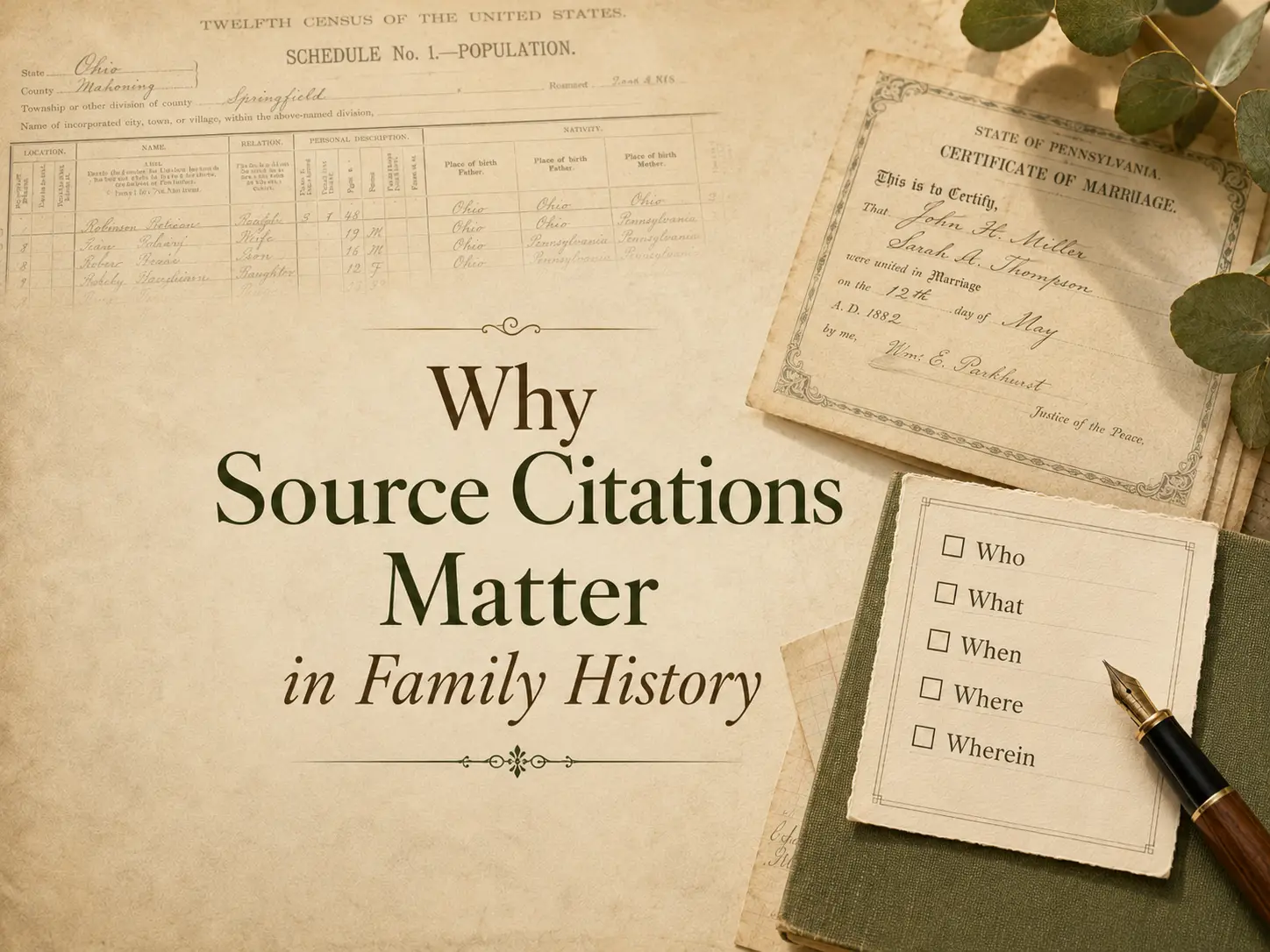
[Image blueprint breaking down a standard source citation into its core structural components: Who, What, When, Where, and Wherein (Specific Item/Image Number)]
- Collection Title: Ohio County Marriage Records
- People Named: Anna Miller and James Thompson
- Date & Event: Married on 12 June 1884
- Place: Boone County, Iowa
- Where It Lives: FamilySearch (Image 412 of 850)
- Date You Looked at It: May 18, 2026
A Gentle Invitation
Choose just one ancestor on your tree this week. Look at three basic facts attached to their name—perhaps their birth, their marriage, or their burial.
Then ask yourself gently: Do I actually know where this information came from?
If the answer is yes, take five minutes to strengthen that citation map. If the answer is no, make a small note and begin the search to find that document again. Approach this task without an ounce of shame or pressure, but rather with steady care.
Because family history has never been about simply collecting a long list of names. It is about leaving a beautiful, visible trail of truth, tenderness, and evidence for the people who come after us.
Let Us Know Your Thoughts: Have you ever saved a family record only to lose track of it months later? Or has a specific source citation helped you untangle two ancestors with the exact same name? Share your brick-wall stories or small preservation victories in the comments below!
Leave a Reply